Search This Blog

Contributors

Showing posts with label Ramblings. Show all posts

Sunday, August 8, 2021

Tieflings: Why do we hate them, again?

Basically this.
Oh right. Its because they've been used so poorly and were reduced to some 'cute cosplay' race. The Tiefling, especially in its current form (since 4th edition) has diverged more and more from the original intent, which was a rare offshoot of human families cursed with fiendish blood but too mortal to be true half-fiends. The modern version, meanwhile, is a mostly coherent race which breed true and has a much more consistent appearance. They are also quite mocked in old school circles due to them being associated with the imagery of modern players doing their Tiefling as some sad misunderstood oppressed minority group. They basically are a darker Half-Elf and a sexier Half-Orc, all wrapped in a nice little package of looking more fantastical and exotic, right?

You're doing Tieflings all wrong.

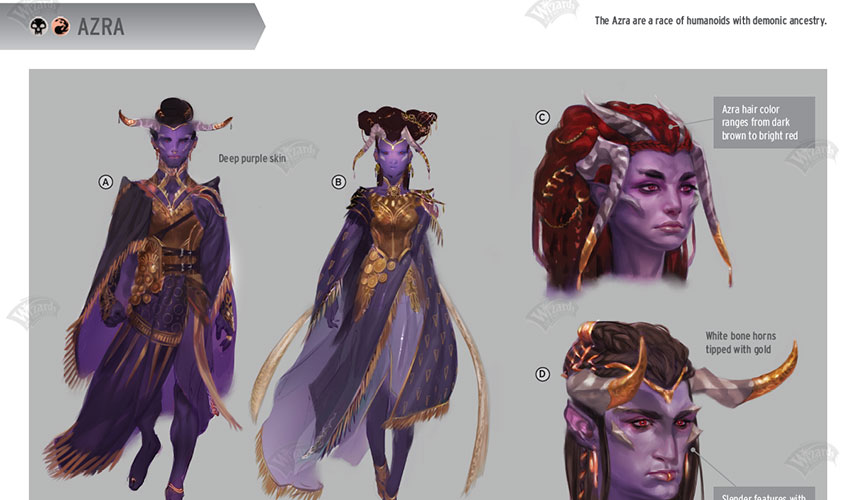
Tieflings are to Humans what Drows are to regular Elves. If Tiefling are to be treated as a true-breeding race, then this requires changing them. D&D 4e did it right with giving them an empire but somewhat screwed this up by having it be destroyed already. So what is the modern concept of the race, really; Tieflings are, simply put, a stable offshoot of human bloodlines infused with fiendish blood.

The solution to making this take on the Tieflings 'cool' is not to humanize them but, rather, returned to defining them by their inhumanity. They are more than human but also less than human. They are everything which defines the human race in most fantasy settings but pushed to a darker, more inhuman extremes.

Its amazing how much mileage one can get out of race by not really changing their core, established lore but rather looking at it differently. Once you examine a race and go back to the basics of the fantasy genre, so much of it click into place. If you want to cut to the meat and potatoes and not read this long ramble, Tieflings are basically just Melniboneans or Dark Elves. They very much fit within that same archetype and could even replace any type of dark elves within a setting if one felt so inclined to have a race that is powerful, organized, evil, dangerous and magically inclined without the baggage of either being elves or the certain other connotations that make people annoyed.

Tieflings History and Nature

Like these guys, but with horns.
Everything that makes a Tiefling what it is, every single vice? These things already exist in humanity and always did. The slivers of fiendish influence in their blood does not make them evil per se. Rather, it simply amplifies and magnifies all the best and worst qualities of humanity. It is this amplified nature which ultimately brings them back to their fiendish roots, as superior ambition, pride and hubris will invariably drive most Tieflings to evil, although some of them are indeed demented monsters with a twisted mind. As with humans, Tiefling exist in all shape, sizes and quality: some are very smart, some are very dumb. However within each of them burns the fires of ambition which has always propelled mankind forward. The desire for more. The desire to compete. To excel. To conquer. The fiendish blood inside them isn't alone in making them evil. It merely nurture a seed which has always been there, which are all too human desires.

Humans in many fantasy setting are often defined by their ambition and their sheer drive, even when they find themselves coming short next to other races which may be more gifted in certain areas, such as magic or physical might. These positive qualities to constantly strive for more, this ambition? This is the very thing which led to the creation of the Tiefling race and the eternal damnation of all those who descend from their bloodlines. When the great god-kings of old realized their kingdoms would never be at peace, that there was always a greater power and more to be found next door, many could simply not take it. Neither could the greatest arch mages or high priests. Humanity has limitations, as do all things but it is human nature to desire more. To be more and to be greater. That is how great men, who could have once gone down in history as paragons of humanity sold their souls to lower powers simply because they had the all too human flaw of not being able to understand their limitations. They saw it as some great injustice or even more blasphemously, as the gods somehow 'holding down' humanity.

And so, many time across history, this pattern repeated itself. At the peak of their power or at their darkest hour, great heroes of mankind fell prey to the promises of power offered by lower powers. They surrendered their humanity and allowed dark powers to completely consume them, giving them greater might and even a partial form of immortality. Their most direct servants and descendants inherited a portion of this power as they were transformed. The dark pacts couldn't claim entire nations, but they could certainly taint parts of it. And so, several times across history, strains of a dark race were born. Still partially human but carrying within them a horrific taint.

Presenting Tiefling Cultures
Nota Tiefling, but pretty close.
I won't go into the details of whatever complex societies Tiefling could form, as that truly depend on a world's specific history. What is important is to coat the society in the right imagery. Understand Tieflings do not see themselves as a 'monster race', especially not on the same level as orcs or ogres. From their point of view, they firmly belong in the category of the intelligent and civilized folks such as their once-relatives the humans, the elves or dwarves. If anything, Tieflings see themselves as rather superior to all of these. They are, from their point of view, free of many of the petty weaknesses of other races. This, of course, plays in the races' sheer hubris which they inherited from their human ancestors. 

Most of all, Tieflings see themselves with a bloated self importance. They are the center of the world or at least percieve themselves as such. In their minds, the average fantasy setting isn't really some human-centric wilderness with many a decaying Tiefling empire or maybe scattered warrior clans. No no, see, that's the human delusion. To the Tiefling, THEY are the civilized folks, the beacon of civilization and peace in a world full of monsters and mad wizards. When Tiefling adventurers are encountered from a far away land, they see themselves as a plucky band of explorers (with maybe a few token members of other races) who most definitely aren't robbing tombs for riches but, rather, returning priceless artifacts to civilization!

Art by Ahmed Aldoori
Of course, most powerful Tiefling rules are still indebted to fiends, serving the lower powers of whatever hellish dimension their ancestors made pact with. This, mind you, doesn't really appear to be all that strange or sinister to Tieflings, especially with generations upon generation of their culture building and expanding on this. They serve the lower powers, who reward them. If anything, from their point of view, the Tiefling's way of serving their dark masters is more noble. After all, demons and their ilk can and will reward you with magical powers and arcane secrets provided you serve them well. Meanwhile, what can mortal kings and petty gods truly offer? Better to rule in Hell than serve in Heaven and all that. Let the weaker men and elves worship oft-silent gods who promise maybe an afterlife, when Tieflings can rise with their ambition, claiming crowns and crushing kingdoms underneath their heels, being showered in gold, wine and of course the comfort of concubines and/or boytoys.

Tiefling certainly have an association with sexuality (if one is fine with bringing that to their game table) but the same taint applies as with everything else. Tiefling sexuality is not a pretty topic and most relationships tend to end as some master/servant or abuser/abused. The best Tiefling couples are those who can manage to be equal partners, constantly testing and hurting each others so they can become stronger or perish. Its all quite masochistic, really.

In spite of their often monstrous features, or because of them, many Tieflings can become object of lust from people who find their stranger traits to be 'alluring' or 'exotic'. While some Tieflings are indeed ugly or monstrous, many of them carry within them the allure and potent physical presence of many of the more deceptively beautiful fiends. Unfortunately for many, this fact is usually more often than not exploited by Tieflings, as is their 'sad and tragic' origin. Being open minded around a Tiefling, to open oneself to them and to show interest is a surefire way to die. Most of them don't see human as worthy opponents, let alone as something to love (a word which, by itself, does not translate to their language well as love and obsessive urges=same thing in their dialect of Fiendish Tongues+Common).

4e Tiefling art
Despite seeing themselves as a cultured and civilized people, few other races truly ever bother interacting willingly with Tieflings. While they claim to praise certain values which may seem fine or appealing, such as beauty, power, ambition or 'loyalty' (which is also different in meaning for them, as loyalty is a conditional term for them), their culture remain tainted by their fiendish influence and remain utterly unpalatable to most other races. Tiefling sports are invariably horrific blood games or even a form of ritualized hunt. Their art is grotesque and degenerate, favoring flesh and bone interwoven with beautiful gems and precious metal. To Tiefling this is 'natural' and speak of the profound, almost mystical beauty of the juxtaposition of violence, pain, love and wonder. To a sane person, a Tiefling artist is a psychopath with sick tastes. The Tiefling, meanwhile, doesn't seem to take kindly to being called a monster because he has a refined taste of painting exclusively with the blood of different sentient races.

The way Tieflings see the other races isn't really all that different from how hegemonistic and imperialistic cultures saw their neighbors. Their superiorty is self evident in their noble bearing, the fine lines of their faces, their sharp fangs, glowing eyes and the complex and varied forms of their horns. Any Tiefling simply has to look their history or even in a mirror to see it self-evident they are a master race and everything else is just ugly. They can turn to their culture and history and see it as self-evident that they are a more enlightened people which have cast aside the yoke of cruel or uncaring gods in favor of a harsh but fair new master, one which values the only things that truly matter in life: power and survival.

So what are Tieflings, then? How do you use them? Simple, they are the dark mirror to humans. They are also the evil and vaguely exotic foreign power which people fear and despise because of their supposed witch ways and worshipping demons, only in their case it is 100% true and more. They are the cruel conquerors, the degenerate empire of sorcerers and the monsters with harem of beautiful women and monsters alike. They are disgusting, vile, base people who are blinded by the idea they are somehow a morally kind.

Friday, January 8, 2021

Worlds Without Number and the Sine Nomine Shared Universe: The Nine Immortals

A short(?) sequel post to this one, which discussed how the various Sine Nomine games could actually be a form of shared universe. This idea was one I used (in an earlier, cruder form) when running my old Godbound game, where Red Tide was made into a distant Realm to the custom one I was using.

The Nine Immortals

Art by M-Ing.
First described in Red Tide, a Labyrinth Lords supplement (and as far as I'm aware, one of the earlier Sine Nomine products), the Nine Immortals are the main deities of the Ninefold Celestial Empire and are described as nine semi-abstract beings (each tied a color and key domain) which appear to be the result of a composite of a centuries-old, if not a millennia-old ever evolving empire constantly syncretizing various beliefs into key archetypes.

In truth, the Nine Immortals (under this version of a shared 'verse) are not simply an accumulation of beliefs, although this does describe them perfectly at the same time. The Immortals began as part of a subsystem or alteration to the Legacy by ancient posthumans seeking to achieve a perfect system which would encompass all aspect of human nature and society, perfectly organized and maintained and they share many common roots with the ancestors of the Ren people found in Godbound. These systems for a perfect and virtuous society began as disturbing totalitarian systems which counted various aspects of people's very lives and nature and while there were indeed malicious roots to it, in time this system would break and reform. Ancient space colony algorithm which calculated the ideal way of life, ideal routine and more of people aggregated into more complex systems of artificial intelligence. Yet as much as these systems were cold, callous artifices which sought to control every single aspect of near posthuman life they also began to subtly change. The exact history and trajectory of these ancient systems are quite unclear and lost to time but some rare sages of Latter Earth believe that these social systems became so all-encompassing in their attempt to simply measure human lives and souls that these very concepts it sought to regulate in turn contaminated the system. From revolution to bloody coup to attempt at peace to more totalitarian rules to more bloody coup, the leftover of these all encompassing systems became more human-like. Human imperfections, archetypes and beliefs infected what was once mere synthetic thought control.

The next evolution of the system came from the concept of Made Gods and Arrayed Godbound, which became icons and eidolon, representing various concepts and social ideals. Great thinker, philosopher kings and also horrific tyrants emerged from this era but they too tapped into the same leftover synthetic systems which had connected society and evolved from a purely electronic form to something more complex as what would become the Legacy truly developed. The Nine Immortals are born of the synthetic patterns combined with human belief. They themselves aren't really self-aware beings but rather exist as thought-form or massive Iterum-spanning idea-spheres as egregores. They are recurring archetypes combined with a broken social control system which has evolved into myth-made-reality. Anywhere that has the influence of these proto-Ren people often tap into this system of archetypes and ideas, which has real power. Generations of Godbound, Legate and Imperator have subsumed themselves (often accidentally) into these 'power grids', which empower Clerics of the Nine Immortals across many worlds. What began as a cold system to crush human will and subordinate it has been taken over by human thoughts, emotions and ideas. It rules over them as God(s), but it is a set of Gods which are entirely controlled by humans. This create a rich tapestry of belief, ideas, heroes and gods which is ever-living and evolving.

Monday, December 14, 2020

Revisiting Fighting Fantasy

Few book series were as influential to my love of tabletop as the Fighting Fantasy books. Despite ending and going out of print in 1995, the series saw a revival in 2002. Of course, to me, the temporary 'death' of the series was meaningless as their staggering popularity in the French market on both sides of the ocean meant that the actual Fighting Fantasy as well as a slew of related or similar books all saw continious printing under the base of "Un livre dont vous êtes le héros". These included the original Fighting Fantasy originals, Lone Wolf and too many sub series and spinoffs I cannot remember. It is possible some were original creations of the French market, leaving many of these series as nothing more than vague memories of my childhood.

These books were everywhere in public libraries and I don't mean just in the sense they had a lot but, rather, that for some inexplicable reason you could always find one you hadn't read before. These weren't new copies either, but older prints that had seen so much wear and tear they turned yellow and had to be repaired with duct tape. Truly a magical find for any kid and teenager, plus I'm willing to bet my neighborhood's library somehow still has a few I never found or read, somehow hidden between old manga or a Breaking Bad DVD. These books introduced me to tabletop RPG mechanics, including the dice rolls and character sheets which made me try to invent my own systems where I could run adventures I'd invent for my friends. Its only several years later that a creepy and shady uncle I haven't seen in decades (Is he dead? Or in prison? Who knows?!) gave me a D&D Player Handbook. The rest was history. However, with the boring lockdowns that will never end and the creep of Canadian winter I'm left to wonder: were these books any good, really? Surely it can't be just nostalgia given how these books are held as classics and have since been given an IOS release. If I was to read one to see if I still like it, what should I pick? One considered one of the old gems, such as the original 'The Warlock of Firetop Mountain'? A timeless classic like 'City of Thieves'? A more experimental work such as 'House of Fear' or 'Creature of Havoc'?

Oh my...

Yeah, no. Fuck it. I'm going for the one where I can ride a Gundam wannabe to fight dinosaurs. I mean, come on!

Thursday, October 22, 2020

So, Dragonlance got cancelled....I guess? Should I even care at this point?

The Heroes of the Lance
I try to not get too political on the blog, even if I am elsewhere. This post is a bit different.

I'm not sure I got anything truly insightful to add about the current Dragonlance kerfuffle going except a general sense of being both bummed out yet relieved. The Dragonlance books have a special place in my heart and are nothing but a source of memories for not so much better times as simply bitter-yet-nostalgic times, namely my high school years which were absolute hell yet also the only time in my life where deeper friendship and camaraderie were at the forefront of my life. While I consider them to be rather simplistic and often mediocre fantasy novels they nonetheless played a massive part in getting me into D&D (and tabletop as a whole) as well as making new friends and introducing them to fantasy. They're harmlessly 'okay' in my opinion and in spite of their flaws the main books as written by Margaret Weiss and Tracy Hickman have some genuine moment of friendship and humanity in these characters which elevate an otherwise fairly basic fantasy story. The Heroes of the Lance aren't amazingly complex characters by any means but I like to think their bonds with each others are genuine and touching at times. Sometimes a story can be basic, simple and bland yet still very earnest.

Dragonlance getting 'cancelled' in 2020 is nothing new, especially with Weiss and Hickman's Mormon roots presumably being quite offensive to the very clearly 'Progressive Consumerist'*-aligned Wizards of the Coast. Maybe I could rant and rave about that. Maybe I'm wrong and there are deeper legal thing going on. Somehow I'm not too mad. Sure, maybe I'm angry enough to write a blogpost about it but really, thinking back I have to ask myself: did we really need any more Dragon Lance novels? I haven't read any recent Dragonlance novels in a long time. The series is utterly massive and, as with any long-running fantasy novel series, most are likely to be pretty hit or miss. Generally, my favorite ones are the Hickman & Weiss. The Age of Mortals and everything leading up to it and following it has been quite a mess which broke the setting. The 'Lost Chronicles' seemed little more than an attempt to recapture the 'good years' of Dragon Lance in the mid-to-late 2000 by returning to the Heroes of the Lance.

Ultimately, Dragonlance was always about the Heroes of the Lance and everything else was, at best, a bonus. These characters have come and gone. Their stories have been told and most of them got killed off or retired. While I could decry the loss of one final trilogy by Weiss & Hickman, to be honest I'm quite glad we aren't getting one. Too much of modern pop culture consist of going back to the classics and adding yet another story after the many endings and ruining it to score socio political brownie points. Let Dragonlance's heroes stay dead and retired. Let their story end. Let me remember them as they were, when I was a young teenager and not as a bitter jaded, aging adult.

They earned their rest, haven't they?

*AKA people who pander to Twitter's so-called 'Progressives' while having extremely exploitative companies full of double standards, predatory practices and encouraging consumerist allegiance while supposedly decrying capitalism. The kind of people who think they 'fight the man'...by buying the product of  a global multinational corporation.

Monday, September 14, 2020

The Yakuza Series, Sandbox and Setting Density

The North American PS2 cover
of the original game.
The Yakuza videogame series, or Ryu Ga Gotoku (Like A Dragon) in its original Japanese title, is a SEGA-produced beat 'em up/sandbox. Originally confined to the Playstation console for a long time, it has since seen the first three chronological entries (or rather, the remakes of two of them) ported to PC. This is how I finally got to play these games since I haven't owned a Sony home console since the PS2 days. This has allowed me to since experience Yakuza Kiwami 1 and 2 (the remakes of the original two games) and the prequel Yakuza 0. As one would expect, the Yakuza series is a beat 'em up/adventure/sandbox game about the seedy Japanese criminal underground and the world of the Japanese mafia, the Yakuza. At least on paper because this is a series which is truly the king of mood whiplash, going from a hard biting crime drama full of drugs and murder to silly side stories about remote car racing or helping a young woman become better at her job when said job is being a dominatrix in an S&M club where she's too nice and polite for her own good. Yakuza is fucking weird.

The real standout element of these games, at least to me (beside hilariously surreal sub-stories) has been its setting, the fictional Kamurocho which is a fictional counterpart to Kabukicho. The interesting about Kamurocho, as a setting for an open world game, are two factors: one, its really damn small and two it return in every game as the story continues ranging from the 1980 of Yakuza Zero to the 2000 of Yakuza and forward into the 2010 and beyond as the series continues. Most open world games tend to go for truly massive scale or at least an attempt at faking it. In addition, most open world videogames usually go for a completely different map with each incarnation of the series to keep exploring fresh. Yakuza, however, completely and utterly sidestep this concept with Kamurocho. While the map does change slowly over time due to the place being renovated and rebuilt (as well as game and engine tweak) as well as adding other areas or places to explore, Kamurocho itself is a mostly static place when it come to its size and shape. The businesses obviously change location once in a while with each iteration of it but this is a fairly natural consequence of life in Tokyo as buildings are brought down, renovated and business change place. With its key streets, features and staple in place from Yakuza 0 to Yakuza 6, Kamurocho may yet be one of the most fleshed out and realized videogame settings out there. While the stories can get goofy and the protagonist ability to dispatch various punks and thugs border on the absurd, the location themselves feel very grounded.

Density Of Details

Kamurocho's oldest map chronologically
in Yakuza Zero (1988)
Kamurocho is very small by sandbox standards. If Tokyo as a whole was a hexcrawl, then it would be but a single hex. The difference is that Kamurocho feels rather 'lived in' and not just because it sometimes looks old and like crap, especially its back alleys. Every store, building, office and more displays a unique appearance of flashing neon signs. Every building is unique, even if due to gameplay limitations only a sparse few can be entered per game. One interesting aspect is that even in the mere few city blocks which forms Kamurocho, one can get a very different 'feel' from their environment, with the main streets such as constantly lit by neon and abuzz with people feeling quite different from the cramped Champion District, which is nothing but super cramped old buildings, back alleys and tiny bar. In addition to all this, there are added details such as the various restaurants which naturally do the locations: those which can be entered by Kiryu (the protagonist) all have their own unique menu of food and drinks, unless its a chain restaurant in which case the menu will be the same across Kamurocho or even other places which can be visited such as Sotenbori.

Another detail of the Yakuza series which is both budget-saving as much as it add to the setting is the fact that, since the world which the protagonists inhabit is so small, they are bound to constantly run into action in the same locations. From random encounter of thugs and drunks as one walk by them to side quest and story missions, there are only so many street corners and buildings in Kamurocho. As one plays through Yakuza, both a single game and sequels, there will slowly form a tapestry of stories which unfolded in certain locale. In any other game, a location called 'Park 3' where homeless people gather would be rather forgettable as a dime a dozen city location that looks like shit. However, in Yakuza 1, when a cutscene occurs there I am reminded that in Zero, more than a decade ago in-universe, this was a location of a quest where some bums want booze and turns you into an errand boy. This may seem innocuous or not-so-noteworthy but within the context of Yakuza Zero the information they give set the protagonist further along the path of starting the story of said game proper and uncover the mysteries of its plot. Playing through a few Yakuza games slowly build a sense of familiarity with Kamurocho, turning even empty backlot into places where some story, no matter how minor, may have happened. For another example, the South eastern parts of Kamurocho are fairly barren streets in mosr games, lacking any major plot location or more than a single diner or a single mini-game location. Yet even an area which seem devoid of content is not, because these streets were the location of other side stories which began elsewhere in the neighborhood.

Is such a small scope setting suited to all tabletop campaigns? Obviously not. However there a few things to learn from Kamurocho. While a location in a campaign may initially just be randomly generated (and that's fine), the small and tightly knit Kamurocho make me ask: "Why create a new location if you don't need it?". Perhaps the next time players are chasing a goblin infestation or trying to corner a thieves band, their enemies run back into a known location which has been previously visited by the players. Describe the same old alleys. There is something to be said about the familiar and it slowly but surely build the setting into its own character. Why create new locations which are described in crude terms once when one can slowly build on top of a pre-existing setting? Of course, it doesn't mean that the setting can't change over time: it will, absolutely. New buildings pop up, old buildings are torn down. People move in, people move out. New criminals enter an area and cut their turf in new ways. However, with a solid foundation of recurring locations it make people, in my opinion, care more.

Tuesday, June 16, 2020

The Glorious Insanity of Xianxia (And how it accidentally relate to D&D)

EDIT: The following is reposted from my comments off Deathblade's video response:
"Hey, that IS my post and the last damn place I ever expected to see it referenced. You have to understand that these were my thoughts as a newcomer to Xianxia and finding it interesting where it did relate to the experience and worldbuilding of modern Dungeons & Dragons. This is in NO WAY an in depth thought process, for one thing I am not that smart secondly these were just my thoughts following a binge of a few novels early chapters and reading up on what would happen later, as I wasn't feeling ready to fully binge a 1000+ chapter novel. That's why I ended up reading your novel, Legends of Ogre Gate, because it was shorter and seemed more approachable. The 'murder hobo' thing relate to some, not all characters.

This was not an in depth analysis, more of an odd moment of realization that the two had more similarities to it than I initially thought. It was not, in any way, shape or form an assessment that D&D or basic western fantasy is Wuxia/Xianxia and never was. Simply some thoughts that D&D's more absurd end game power level of recent editions is somewhat closer to it than other works of western fantasy, such as LOTR or Conan."

And the other comment:

"Look man, in all honestly I did not even remotely expect this to fall under your radar.
My blog is a very small blog that primarily post things related to the indie RPG scenes of the so-called 'Old School Renaissance' meaning generally I'm posting things in circles which involve people older than me. These people are generally more into older western fantasy, such as Conan, Elric or the work of Jack Vance. Anything from Asia is, often to them, completely alien or called 'anime' because these are people who are really not into anything else. I'm a bit of an outlier, being not even in my thirties yet but quite the fan of that RPG style and scene. This was basically a nobody making a small post of 'Hey, this genre I'm getting into is kind of neat' and talking about that subject to a very small audience. In fact, barring a few good posts, I barely can reach 40+ views on minor posts. I am an absolute nobody and never expected this minor post I did for shit and/or giggles to get noticed by a major translator of Chinese web novels."

Artist unknown.
The concept of Wuxia and Xianxia (two overlapping genre of 'Chinese Fantasy') is one which I've mentioned here and there in some shape or for on this blog. Generally speaking, all this stuff has always existed at the periphery of Western pop culture: always present enough to leave an influence but never enough to ever hit big in the mainstream. For example, its no surprise if I mention how the entire Monk class is pure Wuxia and martial art concepts. It's been a genre which is slowly creeping to my headspace as I turn into more and more of a hipster every day.

Oh did I mention how fucking insane this Chinese stuff is?

What, you thought 'wire fu' and revenge tales of kung fu and swordplay was all there was to it? I thought that to too, but going into Xianxia more than Wuxia. This stuff is completely and utterly absurd and even more so its completely shameless in how insane it is. Interestingly, a lot of the core ideas found in D&D, especially more modern editions, seem more out of Xianxia than any Western fantasy:

  • Xianxia Protagonists aren't 'heroes' in the traditional sense and, in many ways, are the archetypal 'murder hobo' given a in universe justification. The world of Cultivation is an absolute banana dog-eat-dog world where every power source exist in a limited amount and every fights over whatever scrap of magic bullshit which can be used to boost their kung fu and magical powers. It is a world with a lot of stratification of power, rule of might and limited resources making it the logical, if slightly demented, conclusion to the adventurer paradigm. This is the ultimate power-driven sandboxing experience where every other antagonist could arguably the main character in their own right, carving up their own kingdoms or grinding away all the XP and hoarding magical treasures for themselves.
  • In many ways, the higher end of the 'power level' of Dungeons & Dragons especially the more one goes into later editions the more it resemble something out of Xianxia. In modern D&D editions, a high level Fighter has so many HP, such a high attack and such good saves that he is basically superhuman to some truly bullshit level which fly under the radar due to everyone focusing on spellcasters. Yet compare a high level Fighter to the average human and you can see he has long utterly surpassed any kind of realistic human limitation. In Xianxia, this is not an accident of mechanics or an afterthought, it is the entire basis of the world.
  • In many ways, the D&D concept of a Wizard is a lot closer to a Cultivator than any historical and folkloric perception of magic. The D&D Wizard, at least when presented out of the box, is a being who can learn to bend reality to his will through sheer perseverance, training, learning and acquisition of magical artifacts and secret techniques. They are basically Cultivators without the Daoist and Buddhist bent and without the martial and physical prowess.
  • It was generally expected that D&D characters would one day 'tire' of the Material Plane and that higher level play was truly intended to take place in other dimensions. Xianxia is full of different 'tiers' of reality, different Heavens and Hells...which are basically more of the same when you boil it down but with bigger numbers. Doesn't that sound familiar?
Of course there are even more stupid and/or crazy things in Xianxia, especially in the Chinese web novel scene which is basically the equivalent to 'Chinese Pulp fantasy' with the same intended demographics. I've barely scratched the surface and only just gotten into this insanity.

Sunday, June 14, 2020

Urban Fantasy: To Not Shy Away From Vice

This is a more unusual post, as it pertain to society and politics but also how it relates to my ongoing work on my Urban Fantasy setting. This isn't exactly a pleasant post and I'm sure that, of all ten people who actually read this blog most will find offense in my rambles. So be it, then. Much of this is going to come as a bit of ramble and incoherent but generally I'm poor at structuring my own words and ideas anyway.

To Not Shy Away From Vice

Let's not beat around the bush here: we are currently living through a mass hysteria, where everything can and must be 'cancelled', erased, destroyed and/or repurposed. In the name of supposedly good ideals we are destroying ourselves and our past. This is what is deemed to be 'Virtue' and to oppose such mindless self-destruction is considered to be 'Vice'. Therefore, this post is me Vice Signalling where others would signal their Virtue. It is what it is, but nonetheless I will explain my position.

There are many times, when writing about or GMing my Urban Fantasy game that I have to address the darker parts of human nature because it is what it is. So why do I call this to 'To Not Shy Away', then? Simple: because self censorship in the name of a certain good is not good, but evil. The cosmos of my Urban Fantasy setting is very human-centric, with the very nature, existence and expression of what makes us human at its very core unlike other worlds where humanity is insignificant. As such a  fundamental value expressed within that world is that the potential for Good and Evil exist in us all. It is a view where pessimism and optimism exist in equal amount. 'Evil' within that world is limited to a type of person or to a certain group, civilization, culture or religion. 'Evil' is what is born from the absence of good and, most importantly, the void created when our very humanity is something we reject and let me tell you: this is no greater embrace of inhumanity than self-destruction. This can take many form, including deliberately shying away from the darker side of humanity to coddle oneself and wrap oneself into an echo chamber.

There are no guidelines at my table (be it a real tabletop or online). There are no rules and no oath anyone will ever force me to take. Do note I wrote force, as obviously trying to be a responsible adult (haha as if!) and adapting to avoid what would truly, seriously disgust my players and friends is fine however that would be something done willingly out of respect for an individual, not to some faceless collective. Unless something is of an issue which someone I trust and respect goes "Well, I don't really like that topic" then I will never shy away from the darker sides of humanity. We are not children. Lastly, to deny the existence of human vices and warts is fundamentally wrong, as is coddling ourselves in believing that only certain individuals are capable of good or evil.

Or, to be crass: Fuck your puritan mindset, I do what I want when I want and you won't stop me from going into horror and disturbing topics. If I am a demon, so are you.

Wednesday, May 20, 2020

Silent Legions or 'How To Do Lovecraft Right'

It's a known fact I hold a very positive opinion of Kevin Crawford's work in so much as his tabletop games are concerned. There's not a whole lot I truly know of the guy overall (and to be honest maybe it's better that way) but he's generally never failed to produce excellent games, especially in the area of his sandboxing tools. KC's work is generally defined, in my opinion, by a strong support and encouragement of GM to build things their own way and providing the right tools for it and nowhere is this more apparent than Silent Legions.

I've bitched about Lovecraft and his mythos before or, rather, why it's a bad idea to use it. Lovecraft's own work is something I do enjoy and find quite good but my issues with it exist beyond the man's original writing. By themselves, these stories are fine. The problem emerge from Lovecraft's mythos being held as some coherent fictional universe by his friends and future writers. To do so completely miss the point. Even worse: to use his mythos for tabletop is generally a terrible idea overall. When looking at the Lovecraftian universe in a vacuum (as in just HPL's story) there is a very clear understanding that we the readers are supposed to not know what horrible monsters and dreadful gods exist just as much as the protagonist is initially in the dark. Knowledge of things such as Great Old Ones and sorcery are limited to older text and personal journals, the kind of things which academic papers or (in the modern time) Wikipedia would not deem reliable. The mythos exist below the surface of accepted historical and cultural details.

The problem emerge when one decide to run Call of Cthulhu or any other RPG using Lovecraft's mythos. People who run and play these games miss the point entirely. They play with a group who knows what to expect. Even if we separate the player/character knowledge there's an implicit knowledge of the expected genre conventions and the overall, overarching mythos or, worse, a desire from the GM to actively reference it. This is a mistake and completely flies in the face of the original texts. There's a reason the better 'Lovecraftian' works of the past few decades have been divorced from H.P. Lovecraft's universe. If the entire genre is built on things man was not meant to know, then why is it that modern Lovecraftian works plays it safe and rely entirely on things the audience know and expect to see? Silent Legions offer a simple solution of offering sandbox tools and GM aide to build their own nightmarish reality.

Otherwise you end up with a group thinking the point of it all was 'tentacles and weird unpronounceable names'. Which I think does a major disservice to the work of Lovecraft.

Friday, May 15, 2020

"But Star Wars will be done my way! I don't care what you (Disney) have to say!"

Star Wars: once loved and adored as the modern mythology, now reduced to a punchline and cautionary tale of corporate greed, mishandling and misplaced politics from the people involved. What happened to the Star Wars we used to know? Well, it's dead and gone. At least as far as 'official' material is concerned.

"No, I am the correct line. Not 'Luke, I am
your Father', damn it!"
The thing is, Star Wars is the modern myth and Disney has no power over me as a tabletop Game Master. They can burn, they can destroy, corrupt and revise the lore as much as they want. As long as someone, somewhere, still has a copy of the original trilogy out there, Star Wars will live. We're not yet at the point where Disney can destroy people's old copies. I'm sure eventually they will be as insane as to remake Episode 1 through 6 and corrupt and twist every character but we're not there yet. I'm lucky enough to have been old enough to remember a time before even the Prequel trilogy, where my father rented the VHS of the original trilogy (in its old, slightly crappy French dubs) and sitting on the couch being blown away by that line. You know, "No, I am your your father!". There was a time where this was still something a kid would be able to watch without knowing it was coming. But enough of more of my 'premature old man shtick'.

You Can Run Star Wars Without $$$

As I was pointed out on MeWe today, there's Mini Six: Bare Bones edition. It's a slimmed down, free version of the Open D6 System, itself derived from the classic Star Wars D6 by West End Games. It comes with a stripped down version of Star Wars, or rather Star Wars with the serial numbers filed off. Why get a copy of Edge of the Empire or anything owned by Disney? You don't need it. What, do you need the 'lore'? The lore is available on Wookiepedia, be it the movies lore, the early WEG proto-Expanded Universe, classic Expanded Universe or the Disney garbage if you feel like a masochist. It's all written down by obsessive fans already.

Of course, in my personal opinion a more 'proper' Star Wars game would require a much more 'minimalist' approach to lore. This isn't me agreeing with the dickweeds at the modern Lucasfilm-Disney about canon. These people are idiots anyway. No, the issue is that while the EU has pretty good stuff its also quite messy. A GM is much better served by sticking to the movies and extrapolating from there, only adding any WEG/EU/whatever else lore if it benefit their game. The appeal of Star Wars originally wasn't in dozen upon dozen of metric tons of lore. I'm aware this may piss off EU fans and I understand, but the reality is there is such a thing as 'too much lore' when it bog downs your game or create arguments with players about what model of gun Storm troopers use or something along those line. To me, the most important lore elements are in the big lines, not the small details. So to recap, what you'd need:
  • An internet connection.
  • Mini Six (Free or a printed copy for about 3$).
  • Maybe a printer, some sheet, pencils and dice.
Now considering most people in this hobby have a ready accedes to paper, a printer, a computer and all that it mean you can basically run your dream Star Wars game for under a few $. I guarantee you whatever the hell you run has a good chance of being more true to Lucas' original vision. It's about the spirit of adventure and cheesy scifi-meet-western-meet-fantasy. Now, to be fair, the prequels had a very different focus and a lot more politics but I'd argue the prequels are material for a group more focused on RP than raw adventure.

Still. Not a penny spent on new Star Wars material. As for my players, I'd encourage them to play into the archetypes. Now obviously, trying to directly copy Luke or Han is a bad idea, but there are many, many archetypes out there in fiction. Not everything needs to be some fancy, fart-huffing deconstruction. Let heroes be heroes and villains be villains, not everything need to be 'deep' (or a faked attempt a depth). Sometimes you just want to have space samurai cutting off space villains with laser swords. There's nothing wrong with mixing your inner child with time-honored mythological archetypes: that's the very thing one should strive for in terms of style and tone.

Monday, May 11, 2020

"Human Fighters Are Boring!" A rebuttal of the idea to nobody in particular

Well, this is going to come off as a bit rambling and somewhat oddly specific to a few people. I imagine anyone reading this blog who is more into OSR-related stuff and plays with older people doesn't deal with this mentality. This is very much a byproduct of Generation Y and Z that plays modern D&D, I've noticed.

I'm sure this is how this post will come across.
There's a bit of a stigma on the Fighter. Especially if its a 'Human Fighter'. The term is sometimes used as a joke by people who like the more fantastical aspects of D&D and fantasy RPG in general. Now I'm not going to shame people who play odd races and more exotic classes, provided that player does it well and in a way that doesn't hurt the game setting. This isn't what I got a beef with. My beef is with this idea that the 'Human Fighter' is a boring character. The idea on the surface has some merit, as it implies a very 'average joe' character on the most surface of level. The character is implied to be some guy (and its usually even more leveled at a guy) who has a sword and maybe a bow. He's that: a guy who is good with a weapon, in a party that usually include things like Tiefling Paladins, Dragonborn Barbarians, Goliath Sorcerers or Gnomish Hexblades or even more bizarre and nonsensical things. Yet in this parade of oddballs and freaks stand one man, an average man, a mortal man with nothing but his sword, his wit, his skill and hopefully a bit of luck.

One would think such a character actually has an innate cool factor. Yet apparently, the appeal of the 'everyman' character isn't what it used to be. To make a comparison to something which these people still find currently very popular, the Marvel Cinematic Universe: the 'human fighter' is Steve Rogers, Hawkeye or even arguably The Falcon (as he's just a guy with a bird jetpack). While some of these aren't the most popular of the Avengers, they're not exactly hated last I checked. Now I know people will bring up that Steve is a super soldier but really, his 'power' is that he was chemically given really good stats all around without being fully superhuman, if you really think about it. And a special shield. Steve is just a Fighter with really good stats all around and a special shield. He doesn't shoot fire, he doesn't levitate and he doesn't have magic. Yet, somehow, when you take these people who are fan of this you'd have to tie them to a chair and torture them to play a 'human fighter'. Pathetic.

I've come to realize the problem isn't 'exotic' races by themselves or even oddball classes. The problem is a fundamental inability to craft anything compelling, character-wise, without the crutch of a character's very state of being. Now I'm not saying everyone should come to a table with 26 pages of backstory, this is often quite useless in any game where you apply a modicum of Old School thinking and remove plot armor. However people have a certain inability to have a certain hook to their character which doesn't require a special exotic race and/or class. To prove my point I've collected a series of ideas, some my own, some found elsewhere to create a compelling 'Human Fighter' backstory that accomplish the following goals:

  1. It provide a fairly simple, yet efficient hook or 'gimmick' to showcase that the character's class lend itself to more than playing 'Mike the generic human guy with a sword' and to show that the class and/or race itself is not the backstory.
  2. It explains why the character is currently adventuring.
  3. It's simple enough to be usable to add roleplay flavor without forcing the game world to bend to an overly complex backstory should the game focus more on dungeon crawl, hexcrawling and/or sandboxing.
In order to do so and be relevant to the currently most popular RPG, I have built these basic character ideas from the Backgrounds as outlined in various Dungeons & Dragons 5th edition books. As an additional limitation, these Fighters will be assumed to be either Champions or Battle Masters as anything else is too 'fancy' and different from the Fighter of older editions.
  • Acolyte: A non-spellcaster disciple of Kord or similar non-evil gods of war and physical might. Big burly dude with high CHA who love history, religious songs and weird fighting techniques like hitting people with a sword's pummel. A bruiser but hardly a brute or an idiot, but possibly lacking in Wisdom.
  • Charlatan: An asshole walking around with very fancy, very polished armor and nice, clean weapons. Pretend to be some holy knight-errant, some prince of a faraway land raised by elves or some other fancy shit. Is really just a charlatan that's good at fighting, a mercenary who over-inflate his prices.
  • Criminal: The usual tough and morally dubious thug. He's a fighter and not a rogue, so that makes him some hired muscle. Alternatively, a bow-focused fighter who is a cold blooded assassin.
  • Entertainer: A professional actor, specializing in re-enacting the plays of the greatest warriors, heroes and demi gods of the land. Fell on some bad times and now is using his weapon and skills to fight actual monsters and not stage props.
  • Entertainer (Gladiator): Need no explanation.
  • Folk Hero: He's from the same mold as humble heroes, farmboys-turned-chosen one and shonen protagonists alike. Good heart, good guts and as dense as a sheet of adamantine master crafted by dwarven smith.
  • Guild Artisan: A smith and craftsman of weapons and armors who has fallen on hard times and, like the entertainer, has turned his skills to more practical goblin-slaying or whatever use. He knows how to maintain his gear perfectly.
  • Hermit: Perfect for the battle master, this guy is some weirdass hermit taking cues from wuxia, living in the woods and trying to master weird sword techniques. His techniques are peerless, or will be with enough practice.
  • Noble: Plenty of possible ways to implement this background, as historically speaking a fighter would have been from nobility.
  • Outlander: Not every guy-from-a-more-primitive-background is a ranger or barbarian. Like the noble this can be done in a variety of ways, from Conan ripoff to even something slightly closer to Aragorn-minus-the-ranger-class.
  • Sage: Not every scholar is a Wizard and not every area of research is safe. With both brain and brawn, this adventuring scholar knows how to fend for himself just fine. While this type of backstory work even better for a Rogue, whose to say this one doesn't prefer a more blunt solution to problems?
  • Urchin: Born in the mean streets, he rely on his raw skill and guts. Unlike other Fighters, he prefer to use crappier weapons rather than nice swords and armors. Probably a concept best reserved for games where Feats are available to further customize in some weird ways. Probably a battle master whose 'special techniques' who are actually cheap tricks like hitting someone in the balls.

Sunday, March 29, 2020

Game Concept: Scifi Television On A Budget

This one is a bit unusual and quite a bit of game gimmick that does not really rely on any system of choice or, indeed, even genre. However for the purpose of this idea I have chosen Science Fiction, as being locked down as made me binge back some old scifi ranging from Classic Doctor Who to Star Trek. Watching so much of it makes you see the idiosyncrasies and the silly elements born of budget constrains.

My Game Has Limited Budget

A mundane, wooden box is a lot cheaper on the budget
than a 'proper' space ship.
Its an odd restriction, when tabletop RPG allows one to use their imagination as much as they want. You don't need to bother about budget. Some people might, a bit, if they insist on using miniatures for Dungeons & Dragons but in my experience that rarely is enough of a limiting factor: people will repurpose a mini and go 'Okay I know its a bandit, but its a hobgoblin'. Most people who use mini and map nowadays use some mat where they can erase and draw at will. Only those gifted with time and skill usually bother to build elaborate sets, unless they are war gamer who can reuse terrain. As a result, the idea of 'budget' is a non-issue for tabletop. Even in an era of supplement creep, there are things like the SRD/OGL and Pathfinder has a wiki where all the info is available. There's no need to buy books.

Overall, anything can happen. A game can be set in any number of villages, cities, biomes or planets with only the GM's words to change the setting. Fantastical monsters can be dime a dozen, spaceships can show up as massive fleets and action scenes can be as overly detailed with flourish as much as one choose to elaborate upon. But what if it wasn't so?

Suppose my game was based off televised Science Fiction, from the sixties to the late nineties. This was the era of televised episodic budget science fiction: immensely popular, yet still not quite mainstream in the way they are now. These shows were often very ambitious but sadly lacking in budget. This is the era of Classic Doctor Who, of the original Battlestar Galactica, of Star Gate, of Babylon Five, of Star Trek from the Original Series to the end of Voyager. Television budget was often a mess. Computer generated images weren't a thing yet or, if they existed, were extremely primitive and limited until the tail end of the nineties. That's why aliens looked like 'men with weird foreheads in funny clothes'. There was no budget to allow twelve feet tall, four armed reptilian creatures or floating psychic amoeba, at least not in any form which would age well visually. Aliens were usually just people in funny clothes, maybe with some makeup or at best some 'rubber suit monster'.

Not only that but the action was limited by budget too, as was every aspect of world building. Most (in)famously is the example of the ubiquitous Transporter technology in the original Star Trek. It existed because some cheap sfx trick was much cheaper and easier to do than build the following: a shuttle's interior, a shuttle's exterior (with launch pad/hangar bay), a shuttle model for it flying in space and maybe oversized parts of the Enterprise's back showing said model landing or launching from the ship itself. It was just easier to add some bad sparkly after effect and make people vanish into thin air, the same way it was easier to make the Tardis magically look like a police box. Both elements would end up becoming so iconic to their respective universe its basically impossible to imagine the settings without them.

What Would It Affect?

Vasquez's Rocks aka 'Kirk's Rocks' aka 'every single
rocky alien planet ever'.
So if a game was ran to emulate this era of television, what would it be like? How much would it change? Would it fundamentally alter tabletop RPG? No, not at all the core elements are still there. This is more of a 'cosmetic' thing and a set of restrictions on the Game Master's part. It would be best suited to episodic games (granted, given my pacing, something closer to a classic Doctor Who serial) to fit the style of the era.
  • All aliens would either be humanoids or rubber suit monsters. The former would range from the obvious cop out of 'human aliens' to 'rubber forehead aliens' while the latter would be better suited to something that's less of a person and more some monster, as it would not be able to convey emotions properly due to the bulky suit.
  • There would be very little, any animals shown especially not alien wildlife. This is too costly. Any set in the wilderness would be some quarry or random forest which just so happen to look very conveniently like Earth. There would be very little exotic environments without straining an episode's budget or trying to get creative.
  • Sets would be quite limited and reused as lot, so if the game is focused on a ship (the Enterprise and the Tardis are good examples) or space station (like DS9 and Babylon Five) it would make heavy use of the same major reused locales as much as it can. When a new set need to be used, the descriptions would try to mention as many reused elements as possible to show its the same old sets with a few pieces added/removed and maybe a coat of paint.
  • There would be a very commonly recurring caves, a bunch of desert rocks and/or a quarry set for any kind of mine shaft, alien tunnels and long lost civilization ruins. That they all look the same would just be a happy coincidence. These desolate locations would be heavily abused as any kind of evil lair or dangerous location.
  • Props face a similar situation. If an adventure showcase some ancient alien artifact which take the form of bronze colored geometric foam and cardboard shapes topped by a crystal, then a later adventure might conveniently happen to have an alien ship control's be a stack of geometric shapes, but in green and grey.
  • Many minor NPC would be recurring actors in different makeup, so some element of their physical descriptions and mannerism would be repeated as the same guy in one episode plays an asshole security guard who gets murdered by an alien and 3-4 episodes later plays an alien trader in makeup.
  • Spaceship action would be kept to a bare minimum, as the budget cannot sustain massive space battles, those requiring too many models and/or CGI. If the game is text-based then as many 'shots' of recurring spaceships would be reused as stock footage. Heavy kitbashing of ships may occur if the game use space ships a lot.
  • Finally, action scenes would be somewhat limited to basic action stuff with some added 'pew pew' laser effects for the guns. This is not the kind of setting where advanced weapons, power armor and complex shields effects can be used. This will result in the characters being a lot more 'grounded' with little to no display of any kind of superpowers, with even supposedly fearsome warrior races displaying little super strength beyond tossing someone to the ground. Psychic powers, likewise, will be mostly effects-less. They just happen without any description of glowy lights and sounds and tend to be abstract. In other words, it isn't Warhammer 40 000 , Mass Effect or Halo, with big spectacle of military scifi and/or space magic.
  • This would also mean monster's abilities would need to be abstract, such as mind control or death rays as graphic things like acid or melting people is not only out of the budget but also not allowed on television.

Wednesday, March 11, 2020

The Importance of understanding the past

This post will certainly skirt my 'no politics on the blog' rule a bit.

I don't really buy recent books (that aren't RPG books, obviously) anymore, there's not really appealing to it. Science fiction, fantasy and horror seems to suffer from a pretty bad exhaustion lately which, combined with the obsession with major intellectual properties which are then destroyed by inept writers (or perhaps on purpose, if you're feeling like being called nuts by people with their heads in the sand) just doesn't really make me want to buy scifi or fantasy novels. The other issue, which I've come to realize following my massive 'born again grognard' phase when I got really invested in the OSR is that fundamentally we (and by extension, most writers) are less and less able to grasp what makes a genre tick.

All we experience in pop culture are copies of copies. Like a telephone game, it increasingly lose its meaning. Ideas. Memes. Tropes. Call them what you want but they exist. Unfortunately people have lost much of their understanding and, when they do spot them, they often generate a sense of hatred for the past followed by a smug satisfaction of pseudo intellect nonsense. The 'trope has been subverted'. Your 'expectations have been subverted'. In actuality it just mean someone wrote crap and felt good about it. No, worse: they felt morally superior.

My most recent purchases in the last few years have been the collected works of H.P. Lovecraft,  Robert E. Howard's Conan stories, an English edition of Tolkien's work (I previous had it as a French translation). More recently (last Monday) I got my hands on Bulfinch's Mythology. Is that book perfect? Hardly, as it is well known that Bulfinch definitely loved to edit out things as to not 'offend' the delicate sensibilities of the Victorian, including young girls. Does that all sound familiar? We should not fear the past and we shouldn't shun it either. If I can keep being pretentious for a moment, I genuinely think anyone out there who is running a Tabletop RPG campaign of any type, but especially fantasy and/or scifi should go out there and read some old mythology. Not the modern takes, not the comic books and Hollywood version where Thor is an alien. These books are, for the most part, either readily available or in the public domain. There is no excuse.

Read some mythology and read some Conan and other pulp works. For science fiction, read the War of the Worlds and other works. You don't even have to like it. I'm not the thought police, you're allowed to dislike it or even think its abhorrent for all I care. Who am I anyway? A nobody. The important point is to at least understand the how and the why of these genres, how they evolved and what form their basis. You can't tinker around with concepts and ideas if there's no grasp of the basics and the core elements. This is how you end with a generation that felt so disconnected from the root elements and the myths that they don't even understand how to play Dungeons & Dragons. Hell, I sure at one point realized that I didn't 'really get it' and then this spiraled in a nearly ten year pretentious-as-fuck phase where I loved to use the term 'deconstruction' as if it meant something. Then one day you get tired of huffing your own farts. You crave the simple, the coherent. Are Conan stories 'deep'? Fuck no. It's pulp, man. However it definitely has lesson to teach on the simple basics of dropping characters in an adventure. The focus isn't on some deeper world building. Its not on some deeper meaning. It's about the how and the why and what adventures this bring.

You have to understand the rules before you bend them.

Tuesday, February 4, 2020

Cha'alt: A Very Early Impression (Not Actually A Review)

This is not a review because I'm too lazy, incompetent and irrelevant to do proper reviews. These are just rambling initial thoughts on Cha'alt. There's a lot of reasons I might end up regretting buying this, namely that I've never been good at running dungeons (let alone a megadungeon). The other one is that I've got some seriously mixed feelings on Venger Satanis, as he's one of those awful OSR-related people who at times is much more interested in his own ego and brand name than anything constructive and he's also a raging edgelord much like the other egomaniacs of the OSR scene, namely Pundit and Raggi.

Do I think Venger and his ilk ever deserve to be on the receiving end of cancel culture? Absolutely not. However that doesn't mean I can't think these people, at times, seem to be wasting genuine talent on childish drama, temper tantrum and a dick-measuring contest of 'edgier than thou', with Raggi getting on the receiving end pretty bad of social media-driven nonsense and rage. Ultimately there is nothing wrong with edge if done right but its hard to not think of them as shock jock that are trying too hard to be as politically incorrect for the sake of some punk-esque desire to give our current culture the middle finger. That's fine and dandy but the question deep down is: is there anything good in all this or is it going to be just edgy bullshit? Time for me to find out. Fitting with these people being a bunch of edgelords, I too will channel my own inner edgelord a tad more for this post.

Inital-est of all Initial Impression

Okay so, Cha'alt. "The Black Pyramid is like nothing you've ever seen before.  Unique design, purpose, feel, magic items, NPCs, monsters, factions, motives, agendas, strangeness, the works!" says the description (and presumably Venger). Not gonna lie, I do have some decently high bars set when it come to weird settings that are both interesting yet also usable, with Yoon-Suin the Purple Land being my all-time favorite. Will this other purple weirdness live up to the hype?

The cover, but everyone already knew that.

Honestly I can't say I dislike this cover, it looks like some cringy-yet-kind-of-funny drug-fueled indie band, which may or may not what Venger was going for. If his (or whatever the fuck his alien pronouns are, 'cuz yeah apparently he now identify as a tentacle alien!) intent was for it to look like the cover to the debut album of some weird '80 band then it totally work because that's the vibe I am getting. Internal layout and coloring is nice, simple and eye pleasing no problem there. Its in color, its good looking and looks quite polished so nothing to complain. At least it isn't MYFAROG (you know, the RPG made by that crazy fucker) whose interior use the Papyrus font. Maybe its unfair of me to put Venger in the same category as an actual murderer, however.

Overall its a decently good-looking book and maybe of even better production value than some of my favorite OSR books. That's praise I am not ashamed in giving where it is due, this isn't a bad looking book. Next question then is will it be filled with nothing but a thirteen years old definition of cool and edgy or will there be really good stuff that is genuinely inspiring? Because its hard for me to take a work where a major location is called the 'Gamma Incel Cantina' which I'm sure will age as fine as a joke as any single joke about Margaret Thatcher made back then or any jab at Donald Trump and Justin Trudeau once they leave politics. In general, socio political jokes age very poorly to the point many of them become meaningless once people get older. Will people know what an 'incel' is in 2040, for example?

More Disconnected Impressions

The initial setting description isn't particularly impressive, to be honest. Cha'alt tries to sell itself on uniqueness but we see basically yet-another-rethread of warmed over H.P. Lovecraft. Cosmic Horror, especially of the Lovecraftian bent, is becoming increasingly trite and the opposite of scary. Cha'alt was once a generic fantasy world but then generic evil tentacle cosmic alien gods came, then there was a high tech age and then finally Old Ones stirred again causing an apocalypse. Meh. Overall it isn't particularly unique so far but I can somewhat start to see where people have mixed it with Godbound, so maybe there's some good stuff in there for me to salvage.

Cha'alt already has a bit of a naming problem too, such as abusing the cliché of making stuff sound alien by adding an apostrophe: Cha'alt, Mela'anj, Kra'adumek and S'kbah are words used. One could be a lot more charitable and say this is a deliberate attempt to evoke the cheese of older Pulp works, in which case its fine enough in my book. Maybe I'm feeling a bit annoyed by it because it is a cliché I too indulged a tiny bit too much in the past with my own failed attempts at making weird fantasy and planetary romance. It wasn't very good or original which I why the project got axed and buried in concrete at the bottom of the ocean.

Drilling home the point of how trite this is compared to something like Yoon-Suin, the race section appoint with not one but six breed of elves. Yeah, fucking elves. That's so original and unique, Venger I've never seen that before. Adding insult to injury there aren't really any other new race added by default: while I'd be all in favor to leave this space blank for GM to invent their own thing, at least one truly unique race could have been neat. This section is a disappointment. I'd say make some table of the traits in Machination of the Space Princess and generate some weird alien freakazoid races, at the very least, to salvage this.

Overall, So Far?

This is honestly pretty disappointing and only further cement my belief that major OSR personalities are often more hype than actual content, with only RPGPundit out of that bunch so far having truly produced anything I find to be quite good. So congrats, Venger, my own curiosity to check this out got me suckered. I'll keep reading and see what else in there but this does not hold a candle to the works produced by Sine Nomine or to Yoon-Suin.

So far Cha'alt is kind of a dud. I know this will not earn me any fans but its true.

Tuesday, December 10, 2019

Tellus: Upcoming Material for 2020!

Arty by Igor Burkalov.
So why exactly has there been so much war gaming content lately (beside the fact I really enjoy it, of course)? The truth is I've been working on Tellus quite a bit but haven't gotten to finalize any of the current content into a form which would be satisfactory to post. Tellus is getting closer and closer to a state where I'd be ready and willing to run it IRL in spite of constantly flip flopping on whether I should run it with 5e or its own homebrew. Of course, none of this really matter to the content which is being worked on. Namely:
  • Name tables for all the major races! I'm going to need standard name for each race, as this is useful to both players and to me, the GM, when it come to naming some NPC on the fly. I've worked on name tables before but never managed to really figure out a thematic for some races which I was satisfied with until recently.
  • The starting zone for my IRL campaign, which is a smaller island which would be roughly equivalent to the 'early game' of a JRPG before the player leave this starting area composed of a few town and dungeons for the main quest. This is probably going to be a 'point crawl' albeit a bare bone one.
  • Some basic and common monsters and some crude ecology. I say crude because JRPG usually (especially the older titles) don't really give a damn about a world which make sense. Nevertheless this conflict too much with my GMing style so some semblance of sense will exist...if only for the really weird monsters to be even more random.
  • More potential character concepts to offer to players in need of ideas.
  • A list of everything the players would expect their character to know, representing all the basic knowledge of the world needed to 'get' it.
  • Probably a starting soundtrack for the campaign even if its music taken from other sources.
This stuff is all bringing me closer and closer to have Tellus in a functional, playable state. Tellus is definitely going to be the main focus for early 2020 on the Amateur Dungeoneers.

Wednesday, November 13, 2019

Status of The Amateur Dungeoneers: November 13

Well, what can I say? This blog has long outlived what I ever expected to be quite frank. This was originally just an attempt and it was quite unclear if there would ever be enough material for me to write down to justify keeping this blog alive. It hasn't exactly been a smashing success by any mean, having remained a very average RPG blog that averages maybe over a little over a hundred views for the really popular posts. It hasn't really made any 'waves' and I never expected it to, as I'm really not anywhere as creative or gifted as other people like Arnold K for example.

Intense Rework Of The Index

There used to be an index of major blog content that was maintained but, as time went on I really forgot about the damn thing. This has come to bite me in the ass due to mislabeling certain posts or forgetting to add the right tag leaving me to scramble to find the post I needed. Well the lazyness had to stop at some point and the Index has been massively updated.

More Setting Material

That's a goal achieved, at the very least! Initially there was a fear of not having enough 'unique' material as the blog lacked its own setting, especially since the original intended one was a half-baked shitty pipe dream that got canned and sent into oblivion for not being really all that good to begin with. Instead the blog has since become host to the so-called 'Random World', my Urban Fantasy material for Stars Without Numbers Revised (using it for modern urban fantasy) and Tellus, the JRPG-inspired setting.

War Gaming!

A whole new type of content for the blog, namely homebrew material for One Page Rules games which are basically not!Warhammer Fantasy, Warhammer Age of Sigmar and Warhammer 40k. Simplified and stripped down it plays really well and really smoothly both online and in person.

Friday, August 2, 2019

Urban Fantasy: I Don't Use Lovecraft's Mythos

No, this is not some smarmy statement on Lovecraft's views which have been discussed by just about anyone smarter than me (which is a lot of people). I'm not here to apologize for the supposed sins of a dead man but rather here to put down my thoughts on Lovecraft's mythos as a whole in relation to my game setting.

It might seem a bit weird for someone who deliberately run an Urban Fantasy game which doesn't always take itself seriously and is basically the sinkiest of kitchen sinks to flat out say that nothing which Lovecraft wrote exist for real in his world. HPL's influence on horror, fantasy and science fiction is so utterly monumental that it seems weird. Its not that I don't draw inspiration from him, quite the contrary but rather that by not using his constructed mythos (not that it was ever intended to be one but it became that way) I choose to both honor his work and reinforce it in my own way.

Simply put? Lovecraft having his creations shoved into various works which exist out of his genre cheapen his work for two reasons:

  • The first is that often it is inserted into a world/story whose ultimate tone and purpose is utterly removed from the bleak, depressing and alienating world that HPL created, where man is but a tiny insignificant spec of dust in the cosmos and where alien powers invariably drive the human mind to madness. Adding this to a world where you're expected to fight monsters and have cool action completely miss the point.
  • Second and more importantly: everybody already knows HPL's work, which too diminish it. His world was one where a thousand horrible secret existed about the universe, where horrible sorcerer and alien entities lurked around every corner and you were supposed to be left wondering just how much existed out there. The bizarre, alien Gods and entities of his accidental mythos exist to reinforce this. They are not the being of our myths: at best our myths contain a tiny reflection of the truth.
Thus by treating Lovecraft as merely fiction it leave the stranger part of my invented cosmos as alien as I want them to be, returning it to the sense of dread and the great unknown. At the same time when I show a world where ultimately humanity still matter I also don't invalidate his work by forcing this conception of the cosmos to exist with his creation. I can draw inspiration from it as much as I want without ever feeling like I'm screwing with his already often-abused work which has been drained of all mystery by decades of over exposure.

Beside nobody find Cthulhu scary anymore. He's a fucking plushy now!

Thursday, August 1, 2019

Phasing Out the 'Random World' ...but it will live on!


The so-called Random World has been my baby for a while now. Born as a thought experiment in fleshing out a world to use for OD&D/basic OSR stuff using nothing but a randomly generated map it has since grown into its own thing. However as a setting it is as usable as it will get and one downside to its randomly generated map is I'm a bit stuck with what I have. Since the setting isn't going to be used on tabletop in the foreseeable future I'm shelving it. Its done. It has been fun and really helped me stretch my creative muscles but it will only go so far.

So now what?

Well there's material in there which is very usable and I'm quite happy with, namely the monsters. The stuff I've worked on for use, which tries to straddle the line between being unique from the basic D&D stuff while still being completely recognizable and usable with a basic system is something I'm quite proud of: these goblins and trolls are pretty simple but hey, I like what I did with them! As such this material is likely to get a redo and get some polish for a later setting.

Goodbye, Random World. You sparked something in me and for that I am grateful. Its a shame I'll never run you as-is.


Sunday, June 9, 2019

Five(ish) Games/Settings I need to play someday

Just a regular old filler post, with some thoughts on games and/or game settings I'd like to try some day but odds are will never get to change to experience as a player or Game Master.

1. Talislanta and Glorantha/Runequest

I'm putting these two together because of how similar they are: not so much as settings (granted you could easily argue they emerged from similar roots in Fantasy) but rather in terms of what they are as games. They're old games with oddball fantasy settings that have basically completely flown under the radar of modern fantasy gaming. Its the very opposite of mainstream and its boring-ass Forgotten Realms and Qel'Dorei or even Golarion (granted, that one has enough pulp love to have interesting elements).

2. Dark Sun

Another odd fantasy setting, this time one for Dungeons & Dragons: Dark Sun is another one of those bizarre settings which doesn't really register in the mainstream of fantasy in spite of having some top notch setting books for D&D 4e (which were arguably the best setting books of that era). What else can I say? I'd love to run it, its cool, its unique and its kind of horrific and depressing in the most metal of ways.

3. Battle Century G

What can I say with this one? I'm a mecha fan, even if it isn't a subject I've mentioned a whole lot on this blog, namely because there isn't much of an interest in the subject matter around the OSR and there's a clear lack of any good OSR-compatible mecha game. Closest that exist is the Mecha Hack, for the Black Hack. Anyway, Battle Century G is one of the few mecha games that seem to generally know what it is doing simply because the guy who worked on it was such a fan of the genre to begin with. The game is easy enough to mods in order to accomodate various style of mecha campaigns.

4. Star Trek Adventures

Now for something completely different: the still-in-publication current official RPG for the venerable (and much abused, sadly) Star Trek license. This one is as far removed thematically and mechanically from anything I've ever mentioned on this blog yet at the same time, having (almost completely, at least as of this post) binged through Deep Space Nine has made me want to run some Srar Trek stuff.

5. Maid RPG

....Because why not?