Search This Blog

Contributors

Showing posts with label 5e. Show all posts

Sunday, August 8, 2021

Tieflings: Why do we hate them, again?

Basically this.
Oh right. Its because they've been used so poorly and were reduced to some 'cute cosplay' race. The Tiefling, especially in its current form (since 4th edition) has diverged more and more from the original intent, which was a rare offshoot of human families cursed with fiendish blood but too mortal to be true half-fiends. The modern version, meanwhile, is a mostly coherent race which breed true and has a much more consistent appearance. They are also quite mocked in old school circles due to them being associated with the imagery of modern players doing their Tiefling as some sad misunderstood oppressed minority group. They basically are a darker Half-Elf and a sexier Half-Orc, all wrapped in a nice little package of looking more fantastical and exotic, right?

You're doing Tieflings all wrong.

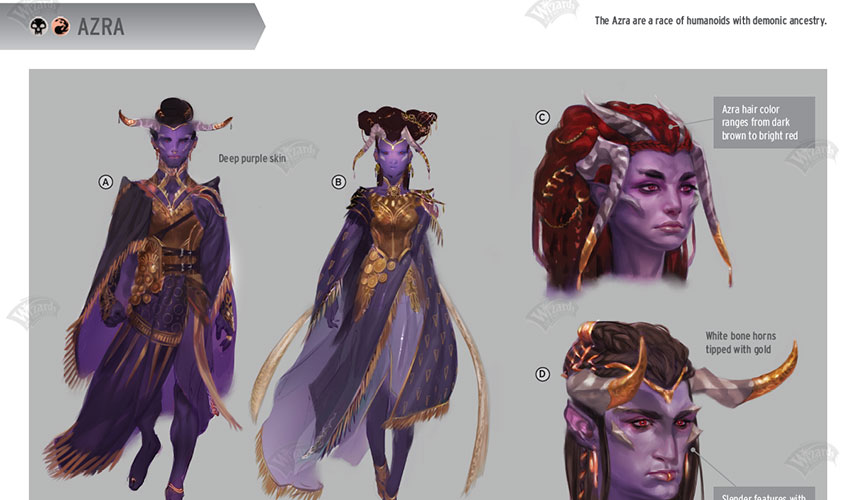
Tieflings are to Humans what Drows are to regular Elves. If Tiefling are to be treated as a true-breeding race, then this requires changing them. D&D 4e did it right with giving them an empire but somewhat screwed this up by having it be destroyed already. So what is the modern concept of the race, really; Tieflings are, simply put, a stable offshoot of human bloodlines infused with fiendish blood.

The solution to making this take on the Tieflings 'cool' is not to humanize them but, rather, returned to defining them by their inhumanity. They are more than human but also less than human. They are everything which defines the human race in most fantasy settings but pushed to a darker, more inhuman extremes.

Its amazing how much mileage one can get out of race by not really changing their core, established lore but rather looking at it differently. Once you examine a race and go back to the basics of the fantasy genre, so much of it click into place. If you want to cut to the meat and potatoes and not read this long ramble, Tieflings are basically just Melniboneans or Dark Elves. They very much fit within that same archetype and could even replace any type of dark elves within a setting if one felt so inclined to have a race that is powerful, organized, evil, dangerous and magically inclined without the baggage of either being elves or the certain other connotations that make people annoyed.

Tieflings History and Nature

Like these guys, but with horns.
Everything that makes a Tiefling what it is, every single vice? These things already exist in humanity and always did. The slivers of fiendish influence in their blood does not make them evil per se. Rather, it simply amplifies and magnifies all the best and worst qualities of humanity. It is this amplified nature which ultimately brings them back to their fiendish roots, as superior ambition, pride and hubris will invariably drive most Tieflings to evil, although some of them are indeed demented monsters with a twisted mind. As with humans, Tiefling exist in all shape, sizes and quality: some are very smart, some are very dumb. However within each of them burns the fires of ambition which has always propelled mankind forward. The desire for more. The desire to compete. To excel. To conquer. The fiendish blood inside them isn't alone in making them evil. It merely nurture a seed which has always been there, which are all too human desires.

Humans in many fantasy setting are often defined by their ambition and their sheer drive, even when they find themselves coming short next to other races which may be more gifted in certain areas, such as magic or physical might. These positive qualities to constantly strive for more, this ambition? This is the very thing which led to the creation of the Tiefling race and the eternal damnation of all those who descend from their bloodlines. When the great god-kings of old realized their kingdoms would never be at peace, that there was always a greater power and more to be found next door, many could simply not take it. Neither could the greatest arch mages or high priests. Humanity has limitations, as do all things but it is human nature to desire more. To be more and to be greater. That is how great men, who could have once gone down in history as paragons of humanity sold their souls to lower powers simply because they had the all too human flaw of not being able to understand their limitations. They saw it as some great injustice or even more blasphemously, as the gods somehow 'holding down' humanity.

And so, many time across history, this pattern repeated itself. At the peak of their power or at their darkest hour, great heroes of mankind fell prey to the promises of power offered by lower powers. They surrendered their humanity and allowed dark powers to completely consume them, giving them greater might and even a partial form of immortality. Their most direct servants and descendants inherited a portion of this power as they were transformed. The dark pacts couldn't claim entire nations, but they could certainly taint parts of it. And so, several times across history, strains of a dark race were born. Still partially human but carrying within them a horrific taint.

Presenting Tiefling Cultures
Nota Tiefling, but pretty close.
I won't go into the details of whatever complex societies Tiefling could form, as that truly depend on a world's specific history. What is important is to coat the society in the right imagery. Understand Tieflings do not see themselves as a 'monster race', especially not on the same level as orcs or ogres. From their point of view, they firmly belong in the category of the intelligent and civilized folks such as their once-relatives the humans, the elves or dwarves. If anything, Tieflings see themselves as rather superior to all of these. They are, from their point of view, free of many of the petty weaknesses of other races. This, of course, plays in the races' sheer hubris which they inherited from their human ancestors. 

Most of all, Tieflings see themselves with a bloated self importance. They are the center of the world or at least percieve themselves as such. In their minds, the average fantasy setting isn't really some human-centric wilderness with many a decaying Tiefling empire or maybe scattered warrior clans. No no, see, that's the human delusion. To the Tiefling, THEY are the civilized folks, the beacon of civilization and peace in a world full of monsters and mad wizards. When Tiefling adventurers are encountered from a far away land, they see themselves as a plucky band of explorers (with maybe a few token members of other races) who most definitely aren't robbing tombs for riches but, rather, returning priceless artifacts to civilization!

Art by Ahmed Aldoori
Of course, most powerful Tiefling rules are still indebted to fiends, serving the lower powers of whatever hellish dimension their ancestors made pact with. This, mind you, doesn't really appear to be all that strange or sinister to Tieflings, especially with generations upon generation of their culture building and expanding on this. They serve the lower powers, who reward them. If anything, from their point of view, the Tiefling's way of serving their dark masters is more noble. After all, demons and their ilk can and will reward you with magical powers and arcane secrets provided you serve them well. Meanwhile, what can mortal kings and petty gods truly offer? Better to rule in Hell than serve in Heaven and all that. Let the weaker men and elves worship oft-silent gods who promise maybe an afterlife, when Tieflings can rise with their ambition, claiming crowns and crushing kingdoms underneath their heels, being showered in gold, wine and of course the comfort of concubines and/or boytoys.

Tiefling certainly have an association with sexuality (if one is fine with bringing that to their game table) but the same taint applies as with everything else. Tiefling sexuality is not a pretty topic and most relationships tend to end as some master/servant or abuser/abused. The best Tiefling couples are those who can manage to be equal partners, constantly testing and hurting each others so they can become stronger or perish. Its all quite masochistic, really.

In spite of their often monstrous features, or because of them, many Tieflings can become object of lust from people who find their stranger traits to be 'alluring' or 'exotic'. While some Tieflings are indeed ugly or monstrous, many of them carry within them the allure and potent physical presence of many of the more deceptively beautiful fiends. Unfortunately for many, this fact is usually more often than not exploited by Tieflings, as is their 'sad and tragic' origin. Being open minded around a Tiefling, to open oneself to them and to show interest is a surefire way to die. Most of them don't see human as worthy opponents, let alone as something to love (a word which, by itself, does not translate to their language well as love and obsessive urges=same thing in their dialect of Fiendish Tongues+Common).

4e Tiefling art
Despite seeing themselves as a cultured and civilized people, few other races truly ever bother interacting willingly with Tieflings. While they claim to praise certain values which may seem fine or appealing, such as beauty, power, ambition or 'loyalty' (which is also different in meaning for them, as loyalty is a conditional term for them), their culture remain tainted by their fiendish influence and remain utterly unpalatable to most other races. Tiefling sports are invariably horrific blood games or even a form of ritualized hunt. Their art is grotesque and degenerate, favoring flesh and bone interwoven with beautiful gems and precious metal. To Tiefling this is 'natural' and speak of the profound, almost mystical beauty of the juxtaposition of violence, pain, love and wonder. To a sane person, a Tiefling artist is a psychopath with sick tastes. The Tiefling, meanwhile, doesn't seem to take kindly to being called a monster because he has a refined taste of painting exclusively with the blood of different sentient races.

The way Tieflings see the other races isn't really all that different from how hegemonistic and imperialistic cultures saw their neighbors. Their superiorty is self evident in their noble bearing, the fine lines of their faces, their sharp fangs, glowing eyes and the complex and varied forms of their horns. Any Tiefling simply has to look their history or even in a mirror to see it self-evident they are a master race and everything else is just ugly. They can turn to their culture and history and see it as self-evident that they are a more enlightened people which have cast aside the yoke of cruel or uncaring gods in favor of a harsh but fair new master, one which values the only things that truly matter in life: power and survival.

So what are Tieflings, then? How do you use them? Simple, they are the dark mirror to humans. They are also the evil and vaguely exotic foreign power which people fear and despise because of their supposed witch ways and worshipping demons, only in their case it is 100% true and more. They are the cruel conquerors, the degenerate empire of sorcerers and the monsters with harem of beautiful women and monsters alike. They are disgusting, vile, base people who are blinded by the idea they are somehow a morally kind.

Monday, July 5, 2021

Thoughts on the Classes of Magic The Gathering and 5e, Part 1

Not something I originally intended to write but, hey, I was asked by a friend to write some more thoughts on ideas and concepts in relation to D&D 5e and Magic: The Gathering, specifically about "What color of mana would each class be tied to?".

This is both a simple and not-so-simple question, so instead I've decided to turn to the absurdly massive array of 3rd party supplements available to 5e. One important concept in Magic, however, is that generally non-human races are tied to one (maybe two, depending on the plane) color of Mana and this rarely changes. As a result, much of this information assume Human characters, give or take a few gifted individuals who could develop far beyond the capacities and association of their race. Of course, the Magic multiverse is vast and near-infinite so just because a thing isn't the norm doesn't mean it can't exist.

Cleric

Mikaeus the Lunarch, by Steven Belledin
In MTG, the Cleric class is heavily tied to White and Black mana, which may initially appear to be a bit odd until one dig deeper. The idea of Clerics being tied to White or Black mana may very well have root in the idea of Good/Lawful and Evil/Chaotic Clerics of early D&D. Combined with the Cleric's ability to either turn and/or command Undead as well as their ability to Heal and/or Harm and suddenly a lot of this make sense. This further plays into classical fantasy imagery, at least before Magic decided it didn't want to do that for brownie points which tend to depict good-aligned Cleric as tied to positive divine forces while the archetype of evil Clerics are those serving demons, evil gods or dark lords.

In recent years, however, with the popularity of the Theros Gods (of all Colors), the idea of tying the divine to just White or Black has somewhat faded, even if the other colors naturally fit other classes better in most cases. Still, any spellcaster whose magic is at least partially derived from faith and/or an entity which may functionally be akin to a god on any given plane could be considered fitting the Cleric class.

White Cleric Domains

Given that White is one of the two colors associated primarily with the class, it come as no surprise that there are many Cleric Domains which are well suited to the MTG color White. These Clerics tend toward the more iconic aspects of the class, namely healing, support and/or waging a holy war of some kind be it justified or not.
  • Life is one of the quintessential Cleric domains, with healing being both iconic to the Cleric class as a whole as well as healers often being of the Cleric class in MTG anyway. This is assumed to be among the 'default' option for White-aligned Clerics across the multiverse and represent the abilities of that color very well.
  • Light is an another obvious contender for being a mainline White Cleric domain and part of the common/innate abilities of the mana type. There are multiple MTG spells depicting White magic as being some sort of holy light including the incredibly deadly Wrath of God.
  • Order (Guildmaster's Guide to Ravnica/Tasha's Cauldron of stupid ideas Everything) represent Clerics which are more aligned to the Lawful side of White mana than some of its kinder and holier aspects, although this need not be entirely the case. White mana has strong association with order and social cohesion nonetheless, sometimes going quite far.
  • Peace (Tasha's Cauldron of Everything) is also within the purview of White, since fundamentally the color is about harmony and lack of conflict. A Cleric of Peace represent the kinder, more merciful side of the color as well as its political side all trying to negate conflict where possible.
  • Solidarity (Planeshift Amonkhet) is very much a White cleric domain as it gets, since the deity it is associated with is mono-white. The domain is well suited to the typical holy cleric with a reliable weapon in hand, some armor and a holy symbol going around being a beacon to its fellow soldiers and adventurers.

Black Cleric Domains

The Clerics using Black mana are (or rather, were) the archetypal 'evil priests' of pulp and fantasy, indebted to dark gods, eldritch entities and more of than not to demons. They are very much schemers and minions, those who serve a dark power for an equally dark reward or those who simply serve it out of fear. While one could certainly image a plane where Black mana-aligned Clerics aren't evil, its difficult to imagine one where they aren't simply neutral at best.
  • Ambition (Planeshift Amonkhet) is perhaps the least 'completely evil' Domain for a Black Cleric and that isn't saying much. The Black color has always been one to focus on ambition, power and achievement at all cost.
  • Abyssal is a domain well suited to demon worshipping and/or summoning Clerics which use Black Mana for their end. Demons are the Iconic Creature of Black mana and so this Domain is well suited to those Cleric who wish to unleash the power of Demons.
  • Pestilence and plagues are a recurring theme for Black spells so it come to no surprise that a Domain of Pestilence would befit a vile and cruel Cleric which use Black mana, using its power to spread death and decay all around.
  • Famine is the twin brother to Pestilence and unsurprisingly, Black can draw upon it too. In turn, Black instill in those who wield it a sense of hunger for more which they can use to spread death, decay and more.
  • The vile concept of the Ur Priest is well suited to a Cleric of Black, especially since few of any of them ever truly display anything resembling faith or any positive qualities. The themes of Black draining and parasitism are well on display in that faux-Domain as well.

Other Colors

Generally speaking, the Cleric class is mostly only found in White and Black. For example, Blue Spellcasters tend to be the intellect-driven Wizards, while Red has the emotion-powered Shaman and Green has the nature-connected Druids. As a result, Clerics of the other three color tend to be a bit more rare. Should they exist, they would likely be tied to Planes which place a strong importance on specific Gods or similar divine entities where an established priesthood could exist.
  • Red Clerics would be well-suited to any Domain tied to violence and conflict, such as War as well as any Domain which give Fire or Ice damage spells. White/Red Clerics overlap greatly with the White Clerics but tend to increase the martial bent of White even more.
  • Blue Clerics are quite rare and mostly tied to Deities associated with Knowledge. To a lesser extent, any Domain that give Ice or Illusion spells can be tied to blue. White/Blue Clerics tend to increase the traits of orderliness found in White, preferring to combine strict law with logic. 
  • Green Clerics are well suited to the Nature Domain or any Domain which ties into natural forces. Anything more would make them overlap far too much with the Druid class, which is very emblematic of Green overall.
  • Black/Blue Clerics have a few domains that suit their (admittedly rare) niche, namely the Madness domain. These would be mad hierophants and cultists worshipping mind-breaking horrors.

Tuesday, June 8, 2021

Thoughts on the Monsters of Magic The Gathering

In spite of how crappy the game has become in so many aspect over time, there is no denying there are aspects of Magic: The Gathering which remain quite fascinating, in spite of how much recent set and settings/planes show that the game is way past its prime when it come to interesting ideas. Yet hidden in the rehashes and lack of ambition there are still monsters which are interesting. Many of these creatures exist either on a scant few cards or as a larger established creature that still has untapped potential. Now some of these I will skip, especially many of the Iconic/Characteristic creatures (such as Angel, Demons, Goblins or Elves) since I don't have anything interesting to say about them or they are established fantasy staples. Other are stranger, more nebulous and despite being established in some capacity across the lore of the multiverse they just haven't gotten their chance to shine.

Archons

Archon of Falling Stars by Victor Adame Minguez
The word Archon is one which I find mainstream D&D has always mistreated. The word Archon means 'ruler' in Ancient Greek and this has powerful connotations yet mainstream D&D has treated them as a fairly bland and interchangeable flavor of Celestials (lets face it, D&D Celestials fucking sucks!). In Magic, however, Archons are creatures of White mana which seem to embody the more Lawful aspect of the color. They are creatures of celestial might, wrath and most importantly of order. Archons in my opinion offer an interesting design space for a glowing, celestial being that is most definitely not one of our modern definitions of good, but rather closer to Old Testament or Pagan sense of judgment and wrath. Physically, Archons appear as luminous beings on a (usually) flying mount and they lack faces, either because it is obscured by their hood or helmet or flat out because it lacks one period.

So far, Archons have appeared a few times in Dungeons & Dragon 5th edition which can give us some limited insight into how they would function and behave as a monster beyond the scope of a playing card. Archons are (usually) resistant or flat out immune to radiant and mental effects as well as non-magical weapons. They are either fused or bonded with their flying mount and they all have some sort of compelling/control spell or a geas. Their thematic as axiomatic beings of celestial/cosmic law with power over mortals is thus well covered by their mechanics which I think make them solid monster and their varied choice of weapons (spear, swords or else) as well as suitably impressive mounts (winged lions, bulls or anything else such as a giant bird) make them quite awe inspiring. Perhaps the prevalance of flying beasts in a setting hint that, in ancient time, these were created and raised to serve as mounts to the ancient Archons? In addition, one interesting and often overlooked aspect of Archons is they are the White counterpart to the Specter type, at least visually.
  • Archons as rulers of ancient humans and establishing civilization, bringing order from chaos, make for an interesting setting role especially since this can be both positive and negative depending on many factors. While an Archon brings about order, they might also be seen as little more than glorified tyrants.
  • In addition to this, Archon make for a suitably varied and interesting replacement for the much more boring and specific Modrons and Inevitables, which are these days very much associated with the major mainstream D&D settings. Not only that, but Archons embody a different type of cosmic law, which is to say order, rulership or even tyranny as opposed to cold mechanical logic.

Baloths

Leatherback Baloth by Dave Kendall
I love Baloth, even if they admittedly aren't very interesting. Now technically 'Baloth' is not a distinct creature type as cards named Baloths are classified under the Beast creature type. Visually, a Baloth is a big pseudo reptilian monster, usually covered in spikes, horns and/or armored plates, however Baloth from Zendikar have hooves and resemble more creatures such as rhinoceros. It is possible that they aren't purely reptilian as infant Baloths are called 'pups' but this could also mean nothing. Baloths are huge, dumb and destructive monsters with a particularly huge appetite. In fact, its the flavor text of Enormous Baloth, in the first MTG starter set I bought, that immediately jumped to me:

"Its diet consists of fruits, plants, small woodland animals, large woodland animals, woodlands, fruit groves, fruit farmers, and small cities."

Baloth, to put it bluntly are very much mini-kaijus and sometimes you don't really need more in a monster. Their key, nay, only motivation is hunger. Baloths are very, very hungry creatures and this all consuming hunger make them omnivorous. This could open up some interesting adventures, as it is likely that magic items eaten by these monsters are simply swallowed whole and left to fester inside the monster's gut. Baloth, in my opinion, are a good monster that walks a fine line between plausible and magical, such as the owlbear. Interestingly, they appear to be something that can be tamed by druids. Interesting tidbit, there!
  • Baloth make excellent random encounter monsters. However, it is very likely that astute characters might be able to guess they are in the territory of one as basically everything has been eaten, with truly massive specimen eating even entire woodlands.
  • Baloth are nearly exclusively Green creatures and spellcasters of Green mana are usually classified as Druids. As pointed out above, it is very likely that Druids can tame lesser baloth and use them as guard animals, mount or even some sort of terror weapon against their enemies. A druid controlling a rampaging horde of Baloths could easily destroy an entire region in days. Baloth can also be made into undead.
  • What use could players have for a dead Baloth? Quite, a few things, actually. Baloth are massive, presumably the smallest adult Baloths would be Large-sized in modern D&D. Their meat and hide may have good enough value; non-magical use might simply be to make super tough leather and scale armor while those used as reagent for magic potions could likely be used to make potions which temporary boost strength or size.

Specters

Abyssal Specter by 'Daarken'
Let's face it, these guys are pretty much a riff on the Nazgûl of the Tolkien legendarium. Mind you there is nothing wrong with that, as the Ringwraiths are iconic monsters of fantasy yet we don't really see much creatures which carry the legacy of terror these creatures once inspired. Physically they are, as pointed above, a dark mirror to the Archons or rather from a real life chronology the Archons are the light mirror to the Specters. Unlike Archons, however, Specters are definitely of human origin rather than some being born of mana and as such as Undead. Beyond that we know very little as only a few Specters have 'flavor text' which speak of their nature and isn't entirely plane-specific.

Specters as depicted in Magic, in my opinion, make for a much better Wraith than those usually depicted in D&D. Their flying mount are way more impressive than just being some flying blob of darkness. Assuming they share mechanical similarities to the Archons when it come to their mount bond, it open up some interesting ideas. Finally, Specters are infamous for their 'deal damage, discard a card' effect which clearly represent them draining mental abilities from the target which is likely carried by any weapon they use as well as the claws or beak of their mount. In a high power game where players have access to flight, Specters make for a great and dangerous airborne encounter. Given the association of Discard mechanics with madness or mental attacks, the Specters abilities to cause discard and Undead nature it might be possible that Specters are the undead form of powerful beings driven to madness. This, at the very least, is part of their lore Ravnica but, again, hard to say beyond that plane. Perhaps, then, their 'mount' is a part of their psyche which is dissociated with them. The two serve the same goals but have different personalities which could cause Specters to have rein in their overly eager or even sluggish mounts. One mind, but two personalities and attention spans, perhaps? Finally unlike Shades, very few Specters have any evasion abilities which make me believe they are at least primarily corporeal despite their name.
  • Specters can work both as major antagonist in their own right or as minions. However, as a creature type in Magic they are somewhat lacking in Legendary Creatures; there is not a single (as of this post) Legendary Specter. This is a bit of a disappointing oversight or, perhaps, it may hint that these creatures are invariably minions, albeit powerful ones. This certainly ties back into their Ringwraith inspiration, even if I'd argue the Ringwraiths would certainly fit the bill as Legendary Creatures.
  • Fighting a Specter is never going to be fun, as their iconic discard ability very clearly represent some form of mental attack. This make Specters a strong contender, among MTG's creatures, as being quite strongly tied to the iconic level drain (or their counterpart in later editions). At the very least, all Specter should have some mean of draining mental stats and/or the ability to disrupt a spellcaster's abilities, possibly making them empty their spell slot!

Wednesday, April 28, 2021

A Tour of the Multiverse, Part 1

Finding inspiration and motivation to resume work can be a difficult process once someone hit their burnout. In my case, finding the inspiration to even write crummy RPG material came in the form of generating material not for myself but for a friend who is (unfortunately for him I'd argue) playing D&D 5e. Now personally I am quite done with that garbage but long rambling discussions and his game concept got me to dig up those pdf and books again. The short version is: he's doing a plane-hopping campaign. It's sort of like Magic: The Gathering but not quite (he never played it until recently and only after coming up with this concept). So all this got me putting together various disparate ideas, some recycled from material long abandoned to create a few worlds for him to drop into a game.

These are less worlds for his main campaign material and more side material for him to use should he need a random location to drop into his game. This experiment take many cues from the Ten Monster Setting but expand it a bit to races, factions or some locations. Its less of a proper worldbuilding exercise and more offering someone a pitch or springboard to expand in their own ideas. As for his players? Don't worry, nobody that young even knows what a damn blog is.

Art by Joel Boucquemont
Laseelai, The Ocean Between

Status: Transitive Plane
Laseelai is a transitive plane which exist between two or more planes and connects to them through their oceans. When the cosmic forces which ebb and flow align, the borders of Laseelai flow into the wider oceans of its connected planes and temporarily merges the two allowing boats to travel in and out of the plane and opening new opportunities for trading. As a transitive plane, Laseelai doesn't really have any borders nor does it form a globe. It just seemingly extend, shrink and blend into other bodies of water with the core of its world, or Axis Mundi, being the bottom of its now sunken continent. In a way, Laseelai is somewhat of a replacement for the Elemental Plane of Water albeit as a less hostile environment for players since it can be crossed with regular boats. Laseelai could be small enough to be the entire setting of a Hexcrawl if one felt like it.

Races of Laseelai

As with most planes in that multiverse, only a scant few sentient races inhabit Laseelai. While the game does embrace the 'weird freaky races all over' mentality so common to modern fantasy, this multiverse at least somewhat offers a reasonable explanation that most races are confined to (and the product of) their homeplane. Laseelai is home to the following races in addition to Humans:
  • Merfolks (Plane Shift Zendikar or Planeshift Ixalan): The Merfolks of Laseelai are partially crustacean based and separated into a variety of tribes, sub races and subtypes each with their own confusing culture even to the natives of Laseelai. These Merfolks appear as humanoid with odd skin color, usually blue, green, red or some beige-tan color and bright markings. They have smooth, hairless skin which erupt into thin exoskeletal ridges usually along their knuckles, knees, elbows, heads or backs but the exact details vary from tribe to tribe. A pair of antenna adorn their forehead and their eyes are either milky white or jet black. Merfolks combine the traditional roles we associated with Wood Elves (the aloof, mysterious natural folks) and Orcs (belligerent enemies). Which role they are closer to depends on their tribe and current standing of said tribe with local Humans. Nomadic tribes also wage wars on other Merfolk tribes.
  • Aquatic Humans (Men and Monsters by Mage Hand Press): A rare but not unknown sub-type of demi-human are the Aquatic humans. Outsiders to Laseelai might believe them to be Human-Merfolks hybrid in the way Half-Elves exist but this is not the case as the two races are completely incompatible. Aquatic Humans appear to simply be an offshoot of normal humans; either some long-lost precursor race or the next step of human adaption to the plane. Or something else. Who knows?
  • See Scrags and Morphoi in the upcoming section.

Monsters of Laseelai

Despite its vast, blue and beautiful landscape Laseelai has no shortage of threats as does any plane in the multiverse. In addition to belligerent Merfolks and human pirates it is home to a near endless assortment of sea creatures ranging from Earth-like wildlife to their giant or dire equivalents as one would expect of a mostly oceanic world.
  • The Scrags (Creature Codex by Kobold Press) of Laseelai looks like bald ogres or trolls with some features hinting at newts. These creatures are almost always chaotic in alignment but can be Good, Neutral or Evil and are extremely selfish creatures driven entire by their own greed, acting almost like ogres of classic fairy tales at their most cruel. They are simple creatures which want life's pleasures such as food or stealing treasures from boats they attack. The more intelligent and less belligerent members of their race are known to be recruited by pirates and used enforcers.
  • The Morphoi (Tome of Beasts by Kobold Press) are dreaded bogeymen, shapeshifting creatures feared by all. Bizarre, plant-based schemers they are utterly alien and depraved and have a role similar to the likes of serpent-men of pulp, worshipping strange gods and perhaps having once enslaved humans. In fact, the Scrags are said to descend from either their slaves, their experiments or might be the cursed descendants of those who defeated the ancient Morphoi. Much folklore exist on their abilities, much of it created as disinformation and so many people assume they are much more dangerous than they are. Of course, perhaps they once were all powerful sorcerer-kings but now are mere shadows of their past selves.
  • Those travelling along the coast of rivers or between islands must watch the sky especially if their boat is quite small, for they might be attacked by one of the dreaded Kongamato (Tome of Beasts), a giant pteranodon-like creature known to attack boats and eat grown men whole.
  • Among the most dangerous creatures (and Laseelai's 'dragons'), the Coral Drake (Tome of Beasts) are monsters lurking among the beautiful coral reef ready to pounce and devour anything in their path. Killing one is worthy of being called a hero.

Five (Simple) Adventure Hooks:

  1. The party's boat is travelling from one location to another but things are not as they seem. There are one or more Morphoi imposters and they have found a way to steer or manipulate the ship toward the edges of Laseelai, hoping to escape the plane and spread their schemes even more.
  2. The party hunt a Coral Drake in order to acquire a favor from a powerful ruler of an island, as offering the skull of a Coral Drake is a surefire way to earn favors.
  3. The party must escort someone or something out of Laseelai before the planar tides cut them off and leave them stranded on the plane for weeks or months.
  4. The party has somehow (or has been incorrectly labelled to have) offended the ancient, unknowable rites or territories of the Merfolks. They either attack or challenge the party to a duel to the death filled with bizarre and obtuse rules.
  5. The party seek out one of the many lost islands of Laseelai to claim some treasure. Reaching it alone can be an issue due to the sea monsters but even getting to the center of the island proves to be harder than expected as it is full of monsters. As they are on the island, its volcano erupt adding further complications.

Thursday, June 18, 2020

Tellus: Starting Again

I've been seriously thinking about Tellus, especially the crunch. Truth be told I've been far too nice to Dungeons & Dragons Fifth Edition. Its still the best edition of 'modern D&D' (3e, Pathfinder' 4e and 5e) but in all honesty it just doesn't suit me all too well and to be honest a lot of recent events have made me dislike the modern face and presentation of D&D to a so-called 'modern' audience. Time to start again, redoing Tellus with some Oldschool-associated core system. More importantly, this will make the game completely self-contained, further tying the setting and game mechanics together in a way which mesh with my tastes rather than relying on the work of some faceless company in the mainstream of tabletop.

Tellus is (mechanically) dead. Long live Tellus!

Monday, May 11, 2020

"Human Fighters Are Boring!" A rebuttal of the idea to nobody in particular

Well, this is going to come off as a bit rambling and somewhat oddly specific to a few people. I imagine anyone reading this blog who is more into OSR-related stuff and plays with older people doesn't deal with this mentality. This is very much a byproduct of Generation Y and Z that plays modern D&D, I've noticed.

I'm sure this is how this post will come across.
There's a bit of a stigma on the Fighter. Especially if its a 'Human Fighter'. The term is sometimes used as a joke by people who like the more fantastical aspects of D&D and fantasy RPG in general. Now I'm not going to shame people who play odd races and more exotic classes, provided that player does it well and in a way that doesn't hurt the game setting. This isn't what I got a beef with. My beef is with this idea that the 'Human Fighter' is a boring character. The idea on the surface has some merit, as it implies a very 'average joe' character on the most surface of level. The character is implied to be some guy (and its usually even more leveled at a guy) who has a sword and maybe a bow. He's that: a guy who is good with a weapon, in a party that usually include things like Tiefling Paladins, Dragonborn Barbarians, Goliath Sorcerers or Gnomish Hexblades or even more bizarre and nonsensical things. Yet in this parade of oddballs and freaks stand one man, an average man, a mortal man with nothing but his sword, his wit, his skill and hopefully a bit of luck.

One would think such a character actually has an innate cool factor. Yet apparently, the appeal of the 'everyman' character isn't what it used to be. To make a comparison to something which these people still find currently very popular, the Marvel Cinematic Universe: the 'human fighter' is Steve Rogers, Hawkeye or even arguably The Falcon (as he's just a guy with a bird jetpack). While some of these aren't the most popular of the Avengers, they're not exactly hated last I checked. Now I know people will bring up that Steve is a super soldier but really, his 'power' is that he was chemically given really good stats all around without being fully superhuman, if you really think about it. And a special shield. Steve is just a Fighter with really good stats all around and a special shield. He doesn't shoot fire, he doesn't levitate and he doesn't have magic. Yet, somehow, when you take these people who are fan of this you'd have to tie them to a chair and torture them to play a 'human fighter'. Pathetic.

I've come to realize the problem isn't 'exotic' races by themselves or even oddball classes. The problem is a fundamental inability to craft anything compelling, character-wise, without the crutch of a character's very state of being. Now I'm not saying everyone should come to a table with 26 pages of backstory, this is often quite useless in any game where you apply a modicum of Old School thinking and remove plot armor. However people have a certain inability to have a certain hook to their character which doesn't require a special exotic race and/or class. To prove my point I've collected a series of ideas, some my own, some found elsewhere to create a compelling 'Human Fighter' backstory that accomplish the following goals:

  1. It provide a fairly simple, yet efficient hook or 'gimmick' to showcase that the character's class lend itself to more than playing 'Mike the generic human guy with a sword' and to show that the class and/or race itself is not the backstory.
  2. It explains why the character is currently adventuring.
  3. It's simple enough to be usable to add roleplay flavor without forcing the game world to bend to an overly complex backstory should the game focus more on dungeon crawl, hexcrawling and/or sandboxing.
In order to do so and be relevant to the currently most popular RPG, I have built these basic character ideas from the Backgrounds as outlined in various Dungeons & Dragons 5th edition books. As an additional limitation, these Fighters will be assumed to be either Champions or Battle Masters as anything else is too 'fancy' and different from the Fighter of older editions.
  • Acolyte: A non-spellcaster disciple of Kord or similar non-evil gods of war and physical might. Big burly dude with high CHA who love history, religious songs and weird fighting techniques like hitting people with a sword's pummel. A bruiser but hardly a brute or an idiot, but possibly lacking in Wisdom.
  • Charlatan: An asshole walking around with very fancy, very polished armor and nice, clean weapons. Pretend to be some holy knight-errant, some prince of a faraway land raised by elves or some other fancy shit. Is really just a charlatan that's good at fighting, a mercenary who over-inflate his prices.
  • Criminal: The usual tough and morally dubious thug. He's a fighter and not a rogue, so that makes him some hired muscle. Alternatively, a bow-focused fighter who is a cold blooded assassin.
  • Entertainer: A professional actor, specializing in re-enacting the plays of the greatest warriors, heroes and demi gods of the land. Fell on some bad times and now is using his weapon and skills to fight actual monsters and not stage props.
  • Entertainer (Gladiator): Need no explanation.
  • Folk Hero: He's from the same mold as humble heroes, farmboys-turned-chosen one and shonen protagonists alike. Good heart, good guts and as dense as a sheet of adamantine master crafted by dwarven smith.
  • Guild Artisan: A smith and craftsman of weapons and armors who has fallen on hard times and, like the entertainer, has turned his skills to more practical goblin-slaying or whatever use. He knows how to maintain his gear perfectly.
  • Hermit: Perfect for the battle master, this guy is some weirdass hermit taking cues from wuxia, living in the woods and trying to master weird sword techniques. His techniques are peerless, or will be with enough practice.
  • Noble: Plenty of possible ways to implement this background, as historically speaking a fighter would have been from nobility.
  • Outlander: Not every guy-from-a-more-primitive-background is a ranger or barbarian. Like the noble this can be done in a variety of ways, from Conan ripoff to even something slightly closer to Aragorn-minus-the-ranger-class.
  • Sage: Not every scholar is a Wizard and not every area of research is safe. With both brain and brawn, this adventuring scholar knows how to fend for himself just fine. While this type of backstory work even better for a Rogue, whose to say this one doesn't prefer a more blunt solution to problems?
  • Urchin: Born in the mean streets, he rely on his raw skill and guts. Unlike other Fighters, he prefer to use crappier weapons rather than nice swords and armors. Probably a concept best reserved for games where Feats are available to further customize in some weird ways. Probably a battle master whose 'special techniques' who are actually cheap tricks like hitting someone in the balls.

Monday, April 27, 2020

Tellus: More Classes from Mage Hand's Press?

Magic Swordsman class from
Bravely Default.
It's been a while since the last Tellus post. The main reason why I haven't worked on Tellus a whole lot is that I consider most of the setting to be 'complete', in so much as having nailed down all the key elements which define the world overall. Everything else would depend on the details of the campaign I'd run with it. All the key information is laid out and easy to digest both for the player and Game Master. That said...

I've got some mixed feelings about 'option bloat'. On one hand I'm all too aware of the damage it has caused to D&D over the years and created this obsession with number crunching and 'builds'. On the other hand, if judiciously used, options can certainly help define a setting a bit more. Given that it is very likely Tellus will be ran with a group that's more focused on a 'modern' mindset I have taken time to gather my thoughts on some Third Party material, namely the entirely new classes by Mage Hand's Press, whose archetypes I frequently link to.

One thing to keep in mind with Tellus is that nothing beyond the core material exist unless I deliberately use it. This is a rule I myself must respect, self imposed as it may be. Things only exist as an option to add to the setting if desired, rather than something which is retconned and crow barred in.

Binder

Should the Binder class exist then the existence of Vestiges is tied to Tellus' Afterworld as it is the domain where ancient and bygone eras of the world (or even, maybe, universe?) exist in a tangible form which is halfway between reality and a living dream. Binder would be a variant of the Warlock, albeit one which is much more rare and ill understood.

Channeler

Intended as a, and I quote, a 'Gish class' (an antiquated term for the spellblade or eldritch knight archetype, taken from the Gith of D&D) the Channeler is a base class whose entire shtick is being a hybrid between a martial and spellcasting class rather than having to rely on archetypes/subclasses or multiclassing. Given a solid point has long been made to make the human and non-human races stand out more from each others on Tellus, the Channeler makes for a good replacement to any archetype which add spellcasting to an otherwise non-spellcasting class. In a way, this could make it closer to the Elf racial class of old, where 'being an elf' was enough to define a character. Given the element focus and martial bent of this class, its quite clear: the Dragon Clans would be well suited to primarily have Channelers. The only issue here is that the class is Intelligence, not Charisma-based.

Warden

Now there's a class which seems tailor made for one of Tellus' main races, the Gigas. Originally conceived during the maligned Fourth Edition, the Warden is a 'tank' class which draws upon the primal powers of nature in ways rather different than the more spellcasting-focused Druid. Here we see a class which is perfectly suited to them: it's strong, its tough and its nature-powered. In fact I'd go as far as to say that, should I go with some racial restrictions, the Warden would be well suited to replace the Fighter for the Gigas race as a whole.

Warmage

Magic, completely tuned to the crafts of war and murder. The Warmage class would be a rather new development in the current era of Tellus, born of the intense magical research for the purpose of warfare which is so common in the Sheradilan Empire. The rare few individuals with magical talent which are found among each generation would be taken (often against their will if necessary) and molded into living weapons.

Monday, April 13, 2020

Wuxia 5e: How I'd Do It, Lazily

Artist unknown.
My relationship with D&D 5e is an odd one: mechanically I consider it to be the strongest and most usable of the modern/WOTC-era Dungeons & Dragons as its not as stupidly designed as third edition, easier to mod and its not fourth edition which, while it has strengths, is such a contentious game that it can't really be used in any way resembling the originally intended form of D&D.

Where 5e shine however is that it has quite a bit of support from third party and homebrewing to a level which went missing during the era of 4th edition. As a result of this more modular design and the handful of homebrew out there the game has never been more modular, at least not since the pre-WOTC days. While I'd personally be quite happy to keep running OSR and homebrewed stuff, my crop of available players in my social circle is a lot more fussy and would rather play the current edition. As a result I've adapted my notes and ideas for a Wuxia game to simply using 5e. Its worth noting there are far better options for things even vaguely related to Wuxia than D&D. This is just meant to be a very quick, very easy to grasp modification which I could use to introduce the average D&D 5e player to some Wuxia and, to a lesser extent, some Xianxia material. Of course, given D&D is very western it would make the game's true genre to actually be 'Xuanhan' but we are getting into dense terminology that would utterly lose the average player. Basically, it's a lot more Chinese-flavored and not the bat-soup or soy sauce kind of way.

Character Options

A key thing with people who play 'modern D&D' is that they expect a lot of character options. That's just the nature of modern game design, people expect to have a lot of frankly very similar options and a lack of options is perceived not as verisimilitude (like OD&D and OSR Fighting-Men) but as some lackluster or even lazy part of the game system. However, this being a Wuxia game much greater focus is put on the following options:
  • Unlike other games where it might be an afterthought, the Monk is one of the two main classes in a Wuxia game, in its myriad bizarre forms and whatever odd homebrew might exist out there. In a world where Martial Arts are central to the setting identity just as much as monsters and gods, just about any type of Monk could exist. In particular, the Swordsage will line up well with the next important class...
  • The second class which is key to the setting is the Battle Master Fighter Archetype and its Maneuvers. With many expansions to the Maneuvers, both official and unofficial, this class will pretty much cover any Wuxia character that prefer to use weapons as opposed to their bare hands.
  • For those of a more sneaky persuasion the Duelist Rogue from Kobold Press's Midgard Heroes Handbook is similar to a Battle Master, gaining specific techniques and tricks to use in battle.
Unlike other campaigns of 5e where characters stick to a single class, the Wuxia campaign would actively encourage players to multi class either into a Monk or a Battle Master to represent the fact just about anyone with a name knows kung fu and/or cool techniques when a fight breaks out, even seemingly pacifist doctors or demure courtesan. The bread and butter of a character's theme/gimmick should be in their chi abilities as a monk or their maneuvers as fighters. Anyone not taking levels in those classes ought to then take some variant with an access to maneuvers or something suitably thematic. One issue with D&D is that anything beyond the fighter and thief archetypes are too rooted in Western culture and fantasy to properly fit in so it requires quite a bit more fussing around to try to fit a square part into a round hole.
  • Druids are less like their new age/neo-pagan 'mother nature' inspirations and are instead odd forest monks who learn from animals and forest spirits: often members of Buddhist sects which have been cast out for various heresies and turned to a life of isolation. The Fist of the Forest or Circle of the Mantis make excellent primary classes and the main source of a character's martial arts.
  • Wizards are weird because one could argue they are, on some level, very Wuxia and Xianxia-esque in their own way. The D&D Wizard's power and magic is drawn from their intellect and knowledge and their overall mastery of their craft, rather than any external power. In a way one could argue that D&D Wizards are a form of 'cultivation'.
  • Warlocks may initially not make a lot of sense, but their highly specific patrons could be refluffed as a form of internal alchemy meant to emulate certain beings and gods or to enhance certain styles.
So to recap: Monk, Fighter, Rogue, Wizard and maybe some highly specific form of Druid or Warlock seems the obvious way to go. The Cleric, Paladin and their ilk are too 'western' to really fit in. Given the focus on fighting with martial arts and/or weapons, it make sense most character be multi classed into something which can properly fight.

What About Races?

All Human. What? It's perfectly valid! In any case, this would still be a setting which is very, very human-centric in spite of being a world of Gods and Immortals. The modern D&D concept of treating fantasy races as another flavor of human is one I've expressed intense displeasure before, however there are still ways to make use of that.
  • One possible way to use this is to play some Special Clan of ambiguously supernatural people. Members of an extended family, this clan are mostly human-like barring a few odd features. Examples of these could be a 'Demon Clan' 'Tieflings' or the strange family of Mountain Men (Goliaths) who live in the north province and are known for their large size and strength.
  • Generally, playing some supernatural being should be limited to about one party member at best to keep it suitably odd and mysterious. Keep in mind none of the Dwarf, Elf, Orc and other Tolkien-esque staples are right out the window here. A possible option would be to refluff the Eladrin or Aasimar stat block for some sort of lesser 'immortal' (Xian).

Sunday, February 2, 2020

Tellus: The Underworld or, rather, Afterworld

Its basically near mandatory for D&D-related settings to have vast underground complexes to justify all the monsters and other things found deep inside the Earth. Tellus is, of course, no different and has an Underworld. Generally speaking, knowledge of the Underworld is limited: there is mostly only folklore and myths to go off as well as concrete knowledge of particularly large caves networks inhabited by monsters. The truth is a bit stranger.

The Tellusian Afterworld

The plane of Esper from Magic: The Gathering
The mythic underworld of Tellus is best understood as being two or more layers which somewhat intersect. The surface layer itself is what one would expect: it is a series of semi-connected caves, often areas of geomantic potency. Usually these are relatively large cave complex with running water connected to underground sea and odd local wildlife. There are many 'dungeons' in Tellus at least partially connected to these, namely because generally dungeons are ruins and ancient ruins have a tendency to have been built in geomantic locations to begin with.

While Tellus doesn't quite have Outer Planes, if one goes down enough, down the deepest chasm and the oldest ruins they will eventually transition into a more pocketed dimension, which is both inside the very surface of Tellus and yet not quite. There has been a lot of mentions here and there of Tellus taking cues from many concepts found in other JRPG (which themselves derive from mythology and philosophy), such as the Lifestream. The Afterworld of Tellus is akin to a mixture of an outer plane, the past and the akashic records made manifest. This Afterworld can be the setting to an entire campaign or, more likely, the type of map which would reveal itself in the final acts of a JRPG. In there are entire domains which are the distorted perception of past eras and zeitgeists. Possible use for the Afterworld (or one incarnation of it, anyway) in a game include:
  • The domain from which an ancient evil, long thought defeated, operates from. This force would be from a world that is a horrid, twisted and broken place as a reflection of its cursed desires. In this case it would be the 'trippy final dimension' where the boss is fought.
  • The idyllic yet haunting manifestation of some antechamber of the dead, where the spirit of a long dead hero could be beseeches for its guidance, to borrow its ancient artifact (or find the location of its tomb to obtain said artifact.
  • The Afterworld could be, at least in one specific incarnation, a secondary world brought into conflict with the surface Tellus. This Afterworld would embody either a lost 'golden age', reflecting on the current degraded state of modern Tellus. Alternatively it could be a more brutal, barbaric place filled with nothing but contempt for the current one.
  • The last home of a dying race currently gone from the current era of Tellus.
  • As a source of ancient, long lost and forgotten technology.
  • As an alternate setting.
  • Or as something as close as possible to an Outer Plane as Tellus has, but that's a bit boring.
It should be noted these echoes of the past cannot be reached through simple spells available to players. These require physical travel or artifacts to travel to and from. If these ideas seem a bit too bare bones, I won't lie that they are still in their infancy and their full potential hasn't been tapped into yet.

Saturday, January 25, 2020

Tellus: Character Concepts (Sky Folks)

Leanne from Fire Emblem
At their most basic, the Sky Folks fills (parts of) the niche occupied by elves in more classic settings: They are an ancient, aloof and slowly dying/fading race. This is such a common archetype to fantasy as a whole that it has long been ingrained within JRPG, to no one's surprise.

Unlike the elves, however, the Sky Folks are much more mortal with a lifespan much closer to that of the other races compared to earlier depiction of elves having massively vast lifespans. How long exactly this lifespan is would vary between Sky Folks clan and individuals. Sky Folks age gracefully, retaining their grace and beauty for a long time but they age from hatchling to adult at the same rate as Ulma and Dragon Clans. This has allowed them to better intermingle and live alongside Ulma.

Arcane Spellcaster

Much of what is deemed 'White Magic' by the Ulma has its root in the magic and mystical traditions of the Sky Folks: they channel the power of rejuvenation, healing, stasis and light more than the chaotic and raw elemental side of magic. The Ulma have long outstripped the Sky Folks in many aspects when it come to magic: having a higher % of their population being magically gifted doesn't exactly translate to 'all Sky Folks are good at magic'. Much of their vaunted prowess is a mixture of myth and tall tale and whatever truth may have existed has long faded in this era, with their knowledge of magic having grown increasingly limited and stagnant. Nonetheless, as adventurers are (usually) gifted individuals it make sense for a Sky Folk character to display such powers attributed to the Sky Folks of old.
  • The expression of the innate magic of the Sky Folks would be the Sorcerer. What Bloodline exactly can vary between aeries. Honestly I haven't found a good Origin which fit well with the Skyfolks (yet).
  • The Bard class, if it exist in Tellus, would be rooted in the ancient songs of the Sky-Folk. The ancient songs of the Sky Folks were said to carry potent magic and singing has long remained ingrained in the general culture of Sky Folks as well as playing various wind instruments. Even a non-spellcasting Sky Folks singer could earn some good money purely by their singing skill and the exotic, awe-inspiring nature of their presence.
  • Sky-Folks are well-suited to the Warlock class but not in the traditional depiction of the class. These 'Warlocks' are not power-hungry dabbler who sell their souls to eldritch powers but rather willing channelers of ancient spirits of great magical potency who willingly lend their aid to the Sky-Folks. The Celestial Patron is a good choice, as is The Dreamer, The Sybil (Kobold Press' Deep Magic: Combat Divination) or any Patron that isn't something ominous or destructive.
  • Given their image of holyness and being very much angel-like, it make sense for Sky Folks Wizards to be Angelic Scribes (Kobold Press' Deep Magic: Angelic Seals). The 'angels' of the Sky-Folks are mixture of abstract beings, spirits of light/healing/whatever and the ascended thoughts and memories of their ancestors.

Divine-Aligned Characters

As with all races of Tellus, the religion of the Sky-Folks isn't something which has been greatly detailed and it doesn't really need to, as it is exactly one would expect: the usual about the light, ancestor spirits, protection, blablabla you get the point. However on average, the Sky-Folks have slightly more divinely-empowered champions and spellcasters than the Ulma or the Dragon Clans, if only just barely. The days of myth where their very songs summoned the Gods of old are long gone.
  • The Sky-Folk Paladin is both a logical yet unexpected choice at a glance. The classic Paladin as a holy warrior empowered by the gods of justice, light and all that-other-stuff make sense with the racial connection to the forces of good and light. However a Paladin is generally a heavily armored frontline warrior, which clash with the lithe and mobile Sky-Folks.
  • A Sky-Folk Cleric is very much one of the ultimate expression of their ancient culture, as they would be a divinely-inspired healer, magician and holy man or woman. Such a character would need a good explanation as to why they are not actively protecting their aerie. However this explanation could be as simple and basic as some divinely inspired youth flipping the finger to crusty elders and going off in the world to do good. Suitable Domains include: Life, Light, Protection or Solidarity.

Other Options

'Martial' characters are hardly impossible for Sky-Folks but they'd be looked at a little bit funny due to people's expectations of some graceful, almost divine magician or gifted singer with a magical voice. Sky-Folks Fighters are generally those who rely on their innate mobility and dexterity rather than frontline fighters who would risk damaging their wings. Rangers might exist too but the other classes are generally unheard of among that race.

Friday, January 24, 2020

Tellus: The (Secret) Origins of Ulma

This setting material is posted here for the sake of expanding the lore of Tellus and adding some content and context to the history of its races. It is worth understanding that this constitute a major spoiler to the world history, not to mention that such information about the true history of the world is virtually impossible to learn in-character. This is all information the players and I, the GM, would want to know to better frame Tellus' history.

The Origins of the Ulma

Art by Brother Baston
One of the first things established about Tellus (when it finally got a name and some concrete lore) is that its current dominant race are the Ulma (aka Humans). It was also stated rather clearly that, overall, the Ulma are the least magically gifted race, with a comparatively small portion of their population having a natural affinity, stated to be about 'one in several hundred'. This of course is mechanically supported by the 5e version of Tellus (currently the default unless I feel like making my own homebrew) by restricting Ulma from taking the Sorcerer class and the fact human mechanically lack any racial ability which could be constructed as magical. They are the normal, the mundane or even (to some) the boring race. But why, exactly, are the Ulma so disconnected from magic? Well it is more accurate to say that it's Tellus' own magic they haven't adapted to.

The true origins of the Ulma lie in the distant past of the Tellus universe on a planet named Phaeton, a planet very similar-yet-different to Tellus. In the ancient past of that universe, planetary travel was possible with portals, bridges of starlight and similar high magic/scifi concepts. Indeed, if Tellus was part of some long-lasting JRPG series there would be at least one entry somewhere in the franchise which would be highly controversial due to switching to scifi rather than fantasy. Such an hypothetical entry in the franchise would be the oddball of the franchise, taking place on the planet Phaeton and seemingly being disconnected from the franchise as a whole, at least on the surface. We will call it 'Game N' for the purpose of this long ramble.

So 'Game N' happen and is generally seen as weird by the hypothetical fans of the hypothetical Tellus franchise due to being much more rooted in science fiction than the typical fantasy fare of Tellus. The truth however, be it at the time or decades after via retcon, is that 'Game N' is a prequel. Phaeton is the original world of the Ulma. They are alien to Tellus and the reason they appeared out of nowhere on Tellus, being the sapient mammal race of the world is that they are were not originally native to it. What 'Game N' showed as an unconnected setting was, in fact, the true home of the Ulma. Their birthplace.

Geomantic Attunement

The reason why Ulma are less potent with magic is simply that the Ulma of Tellus are the unmodified, unadapted strain of the race. Their race first arrived on Tellus in truly ancient times, in some long-last age of the prequels or something along those lines. These ancient Ulma, or the 'Ancients' for the sake of clichés eventually adapted to the various geomantic forces which saturated Tellus. This true origin was hinted at in the possible optional races of Tellus, as written here and here. The Ancients ceased to exist as a race because their descendants became different races, infused with and connected to their adopted home. However as Tellus underwent many cycles of geomantic changes, ebb and flow many of these races faded into myth as these races were dependent on Tellus' magic to sustain their existence. In times when these energies ceased to flow freely, more and more of their descendants reverted to their base state.

When the second batch of Ulma arrived from Phaeton much later, they intermingled with these slowly dying races and their unique traits, already on the decline, faded away to become mere anomalies within certain bloodlines. It is unclear on how or why the second wave of Ulma never adapted to become adopted children of Tellus. Perhaps they arrived during a time where the world was particularly hostile to them and saw fit to reshape Tellus to their own needs rather than adapt to it. In time, entire clan and nations of these strange, magically-deficient yet hardy aliens arose and spread across Tellus. Such was their numbers, might and cunning that perhaps no one ever really felt the calling of the planet. They remained (mostly) true to their original nature and not once did they ever really question the why of their disconnect.

Thursday, January 23, 2020

Tellus: The Dragon Khanate

The Dragon Khanate is on the decline, yet its power remain nothing to sneeze at. In the current age of Tellus it is the main rival to the Sheradilan Empire when it come to sheer scope and might, yet the Khanate is also very much a different beast altogether from the Empire. It is also the last great world power to be primarily ruled and populated by non-Ulma, namely the people of the Dragon Clans. The Dragon Clans are not a dying race by any mean, certainly not in term of numbers (barring a world-spanning genocide, they won't be gone anytime soon), at least not within the next few centuries. However it is safe to say their territories and overall might has severely declined in the current age which is Ulma-dominant.

The Dragon Khanate

Art by Charlotte Kuger.
The Dragon Khanate operate primarily from the southern continent and various smaller islands around it. Its heart is the aforementioned southern continent and the various, disparate populations and clans of the Dragon-blooded men and women living on it. Some clans are mercantile, some are pirates and some are purely warriors with a few composed nearly entirely of mystics of some stripe or another. It has allies and tributaries all across the southern seas, spanning many cultures including many offshoot of the Ulma which are far removed from the mainline culture of the other continents, such as the tropical islanders and mariners or the mysterious people of the far eastern lands.

In theory all those are vassals to the great Dragon Khanate, last great power on Tellus not controlled by Ulma. In practice it is a little more complicated, as the Khanate  is nowhere as strong or as unified as it used to be. Without a strong leader, the various clans have returned to their bolder, more independent ways as the boundless energy and pride of the Dragon Clans are hard to contain. In older times, the Dragon Clans could raise great armies composed of Dragon-men, tamed giant beasts, war-mages and more while calling upon the seafaring skills of the islanders to help them raise great fleets of dragon-prowed boats. In the current age, they are an increasingly disparate people and the great armies of old are nowhere to be seen. Not that it stopped them from kicking the Empire's ass multiple time, as inferior numbers and infrastructure hasn't stopped the Khanate warriors from trying to fight, casualties be damned. After all, the Dragon Clans are notorious for fighting their hardest when cornered.

This is the state of the Khanate today: it is still very much alive and very much a raging fire, but it is not a unified bonfire and more akin to a thousand smaller torches. Some of their ports remain open to strangers for trade, large and lively exotic bazaar which deal in so many odd curios. Small fleets of pirates and/or merchants prowl the oceans. However, should the Dragon Clans fail to unify their fire will slowly fade as the Ulma overtake them....

Wednesday, January 22, 2020

Tellus: The Sheradilan Empire

Art by Naranbaatar Ganbolt.
The biggest, most common cliché of JRPG from the 'classic' to the 'modern' era has always been the mandatory Evil Empire out to conquer the world, usually uncovering or abusing some ancient power source and/or ancient evil which may or may not hijack its apparatus. It's been there in Final Fantasy since the second game with the Palamecian Empire and its still going strong in the series to this day with the Garlean Empire of Final Fantasy XIV and Niflheim of XV. Now while the term used is 'Empire' (presumably because it evoke power and expansion) they don't really have to be an Empire in the actual definition of the term and many of the common and famous examples may not have a political structure which match the most famous historical Empires: the Roman Empire, the Holy Roman Empire (the king of oxymoronic names!) and the British colonial empire.

Being 'an evil Empire' in these games is more of a state of mind and of role it plays within the setting and plot: Shinra Corporation from Final Fantasy VII is a mega-corporation but its pretty much plays the token Evil Empire role in the early game. The 'Evil Empire' exist to provide waves of militaristic, expendable mooks to throw at the players, evil commander/generals/whatever to act as named minor antagonists and often a few doomsday threats to the world. Their predominant colors are red and black more often than not, possibly to evoke the Nazis (in spite of those guys not really ruling anything for an extended period of time and collapsing fairly quickly, compared to the Romans). Often these Empires don't...really make sense to be quite honest,  being cartoonishly evil and seemingly so unstable as to collapse as soon as the Emperor is killed by a teenager. Historically, Empires weren't so easily clear cut even if they would certainly appear as the aforementioned all-conquering force of evil to those on the wrong end of their war machine.

In Tellus, the token 'Evil Empire' is the Sheradil Empire. However because I realize my game will not be confined to the railroad plot of a classical JRPG there is a very strong possibility this empire may end up playing a different role or end up explored in ways not intended which would require me to flesh them out beyond being a mere caricature.

The Sheradilan Empire

The Sheradilan Empire is the greatest military power in Tellus. Of course, this isn't really saying much in the current era of the world, as the last centuries have been generally on the decline overall. While currently there isn't an explicitly detailed timeline for Tellus its safe to say that the last few centuries have been that of re-growth following the collapse of older powers. Overall the Ulma have spread across the world even more, growing in power and number in spite of their great nations of past centuries having grown in size, collapsed and grown again. Of the current world order the Sheradil Empire stand at the top as the most powerful.

It was not greed or a desire for conquest which forged what would become the Empire but a simple need for survival. Tellus can be a notoriously wild place, filled with all manner of monsters and odd geomantic locales. There was strength in unity and such a place was fertile ground for someone to unite disparate people. The Sheradil Empire is made of the original union of three city-states:
  • Sheradil, the military and (former) political powerhouse. It is Sheradil which used to provide the military might, with its ancient orders of knights populated by its various noble houses while the common populace enlisted willingly. The leader of Sheradil (the city) is also the leader of the Empire's military, the Lord Marshall.
  • Zerim was a small enclave formed by mages united by a common cause (survival of their research, their secrets and their lives in that order). While the smallest of all three original city-states it is the most powerful in modern Sheradil's politics as it formed the basis of the magical research & development which fuel the Empire's growth. The Grand Magus of Zerim is the most powerful spellcaster in the Empire and, possibly, the most powerful Ulm in the world. He's also quite, quite mad.
  • Phelmus and mercantile networks and ports fueled the Empire's economy and navy. It is ruled by mercantile guilds which are heavily intertwined with the research and development of Zerim. The Guildmaster of Phelmus may very well be the richest (and most corrupt) man in the world and his greed knows no bound.
Together these form the Triumvirate which rule directly below the Emperor, who is always drawn from the various noble houses of Sheradil. While in practice this meant (in ancient times) that Sheradil held the most power in the Empire this is increasingly less true, with the last few Emperors having often been either inept puppets of one or more member of the Triumvirate or madmen all too eager to fuel the expansion of Sheradil's resources. A few well-meaning idealists and noble rulers did exist but these are increasingly rarer and tend to conveniently die to 'clean up' the line of succession.

The Threefold City

Art by Volodymyr Shvacko
The three original cities which formed the early Empire are no more, having merged together in one mega-city which span the entire peninsula where the three city-states laid. The Threefold City (also called the Imperial City) is gigantic marvel whose sheer scope and level of advancement has not seen since the days of myth. There are massive 'garden' spanning between its major districts: some are major geomantic points which have, for whatever reasons related to their harnessing, not been turned into churning magitek factories. Others are parks and domains for the various noble houses to enjoy greenery and the traditions of hunting while others are magically-attuned farmland, drawing energy from the nearby geomantic points to renew themselves and provide food to the city.

Such level of advancement come at a price, however: for one thing, the Empire's resources to maintain such a massive city are dwindling. Law enforcement is also a concern and there are many horrid slums and other terrible places to live, where squalor and thievery are common. Some speculate the city just can't sustain itself forever and this has spurred the Empire to conquer more lands and acquire their resources. Others speculate that Mages guilds are slowly accidentally corrupting and polluting the city with their experiments, unsettling the geomantic energies and causing spontaneous unstable phenomena. Others say they are even releasing their experiments in the city sewers but this has yet to be proven.

The Imperial Army

Even today, with Sheradilan patriotism slowly on the wane (since a lot of people feel they're less fighting for their city/nation and more for the Guilds), Sheradil maintain a large volunteer army. Joining the army is a good way for one to improve their lot in life and this remain true even today. The army is large, well organized and well-equipped and offers some pretty decent opportunities for a commoner to rise through the ranks all things considered. Others volunteer to avoid prison and there are quite a few regiments raised entirely from criminal and slum rats. A few have even risen to the rank of general purely from their merits and ruthlessness, which is insulting to the commoners with a clear record and the nobles alike. In truth these ruthless bastards come from the ranks of those whose talents are well suited to the Guildmaster and Grand Magus' plans. If the game ever call for a General to be a ruthless and almost stupidly evil individual, it would be one of those.

In addition to the rank infantry and the nobles (who form elite corps, often armored cavalry and/or command), the army boast a fairly large navy and, much more importantly, elite corps of battle-mages. While magical talent remain rare among Ulma, the Magus have long studied the phenomena and produced many training regimen which could help foster some weak or even dormant potential. While these individuals might never rise to a high level of power, even the weakest of spells is an important asset. There are also rumours of the Grand Magus attempting to magically imbue and mutate individuals but this too is unproven. What is more common is the (relatively) new corps of war mages, trained exclusively in spells designed for battlefield use. This ruthless, purely scientific and pragmatic approach to magic is utterly devoid of any spiritual aspect and focus exclusively on getting results: namely bigass fireballs and spells designed to enhance or weaken multiple individuals at once.

Dissent from Within?

One generally expect an 'evil Empire' to have some rebellion going on, possibly because of how famous Star Wars is. In truth, right now I have not written down anything which cement the who and the what of any rebellion. It is, however, accurate to say that there are plenty of people within the Sheradilan Empire with a reason to hate the status quo, such as:
  • Nobles tend to be either battle-hungry elitist assholes or people lamenting the loss of nobility of their caste, who are now reduced to being either bloodthirsty conquerors, pencil-pushing bureaucrats or petty politicians. Sheradil noble lines were founded from the great heroes who battled under the banner of the Empire's founder. They fought monsters. They protected people. This idealism was lost over time.
  • Sheradil's various religious orders have been long-deemed obsolete. Symbolic, at best. Whatever complex faith these people had has fallen by the wayside and the spiritual is increasingly neglected, with the magical and divine being more and more seen as a tool for greed and conquest.
  • Some Generals have grown dissatisfied with the many wars they have waged and which ended in a stalemate in spite of Sheradil's great power. Often the simplest solution to win a conflict was rejected by the highest echelon because doing so would harm the schemes of the Grand Magus or potential future assets for the Guildmaster. Entire regiments have been lost to protracted campaigns which could have been more easily resolved. In some cases, the peaceful surrender of the enemy was told to be ignored.
  • The sewers and slums are full of people living in abject poverty. It is also possible that a population of cast off 'mutants' may exist down there, eager to destroy the Empire which made them suffer.